“Innovation doesn’t happen by chance”: inside the NERE Incubator in Évora
November 20, 2026
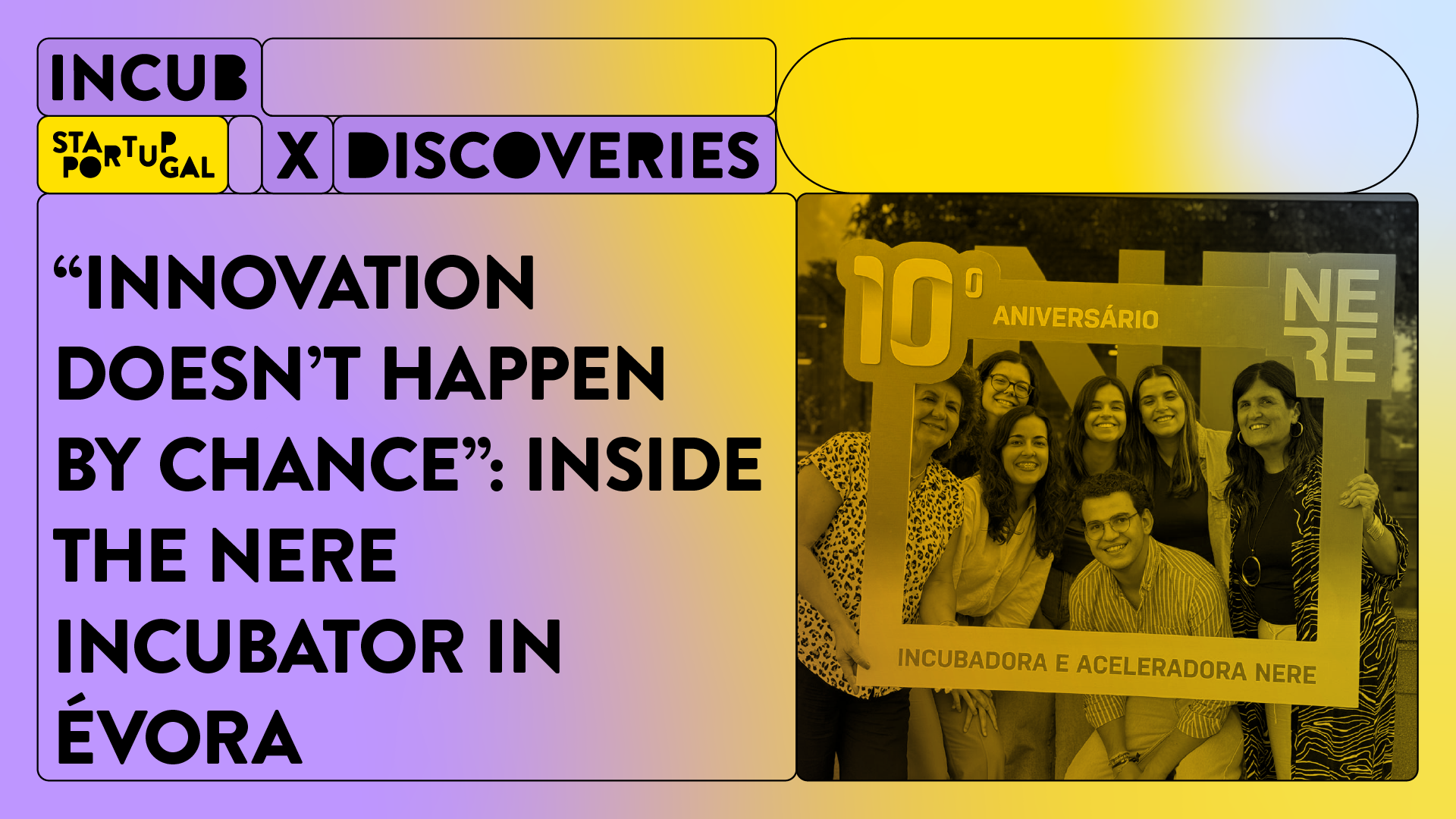
In this edition of #IncubXdiscoveries, we travel to Évora to discover the NERE Incubator, which turns ten on November 27. It was created to fill a gap in support for innovative companies in Central Alentejo, and it has since backed more than 500 entrepreneurs and businesses. We spoke with Paula Paulino, Director, about bringing companies and universities closer, the story of IMPACT Commerce, and building a community that grows together.
This content is available in Portuguese.
How did the NERE Incubator and Accelerator come about? What kind of projects do you incubate?
The NERE Incubator was born from a strategic vision for the development of entrepreneurship and innovation in Central Alentejo.
In 2010, during the preparation of the Alentejo Regional Technology Transfer System (SRTT), which brought together more than 30 entities from the region’s scientific, technological, and business ecosystem, an important gap was identified: despite the existing potential, there were no structures capable of supporting the creation, establishment, and growth of innovative companies.
It was in this context that NERE presented the project to create a Business Center, designed to be much more than an office building. The first phase opened in 2015, the second in 2016, and the third, which completed the Acceleration space, in 2022.
Since then, the NERE Incubator has established itself as a driving force in Central Alentejo’s entrepreneurial ecosystem, supporting more than 500 entrepreneurs and companies at different stages of their path. In addition to physical, coworking, and virtual incubation, we provide integrated support in innovation, qualification, internationalization, funding, training, business cooperation, and project development.
Do you have an area of specialization?
Yes. The NERE Incubator has a clear specialization in innovative and technology-based companies, favoring projects with high growth potential and strong knowledge intensity.
Our priority areas are information and communication technologies (ICT), innovative companies with strong knowledge specialization in the region’s strategic areas, and the creative and cultural industries, sectors we believe are key to the diversification and competitiveness of the Alentejo economy.
We also give priority to incubating companies that are already certified as startups by Startup Portugal or are in the process of certification.
What does your incubation model look like?
Our incubation model is based on close, personalized support, adapted to the needs of each project.
Incubated startups receive support in validating their business model, preparing funding applications, developing management skills, specialized mentoring, access to training programs, networking, and connections with companies, investors, universities, research centers, and other players in the innovation ecosystem.
One of our main differentiating factors is our integration into a solid and highly collaborative regional ecosystem, built over several years and strengthened after the creation of the SRTT. We work closely with the University of Évora, polytechnic institutes, and the region’s research centers, promoting knowledge and technology transfer to companies. NERE also partnered with the municipalities of Central Alentejo, helping identify spaces where new business projects can set up or expand; with entities such as IEFP, supporting job creation and access to employment and entrepreneurship incentives; and with IAPMEI and CCDR Alentejo on licensing and funding.
We are also an incubator certified by Startup Portugal, accredited by IAPMEI under the Startup Visa and StartUP Voucher programs, and accredited by IEFP to support self-employment projects, namely through the Empreende XXI program.
Tell us the story of a startup that left its mark on the incubator. Where did incubation with you make a difference?
When José Balça, now partner and General Manager of IMPACT Commerce in Portugal, came to the NERE Incubator, he started out working from our coworking space while still working for the Swedish company. Along the way, after several challenges and development opportunities, a visit from the CEO to Portugal revealed the potential to create a national operation, which was made possible by Swedish capital investment.
Present in Portugal since 2017 and headquartered at our incubator in Évora, the company specializes in e-commerce consulting, omnichannel, and software engineering. It steadily consolidated its activity and later became part of a Danish group. IMPACT Commerce has been establishing itself in national and international markets, working with leading brands such as The Navigator Company, Renova, the Associação Nacional das Farmácias, and Ericeira Surf & Skate.
In 2025, the company announced plans to invest more than €10 million in Portugal over the following three years to grow its national team, which then had around 50 professionals and could reach 100.
Throughout this path, NERE has sought to play an active role in integrating the company into the regional ecosystem, promoting institutional contacts and facilitating connections with entities that are strategic for its development. One highlight was building bridges with IEFP, namely its Vocational Training Center, to qualify and train the company’s professionals, as well as bringing the company closer to the University of Évora and other entities in the region.
Failure is also part of the journey. What is the biggest lesson from something that did not go well?
One of our biggest lessons was realizing that innovation doesn’t always happen where we initially expect it. When we started, we believed the projects with the greatest impact would come mainly from larger companies, and that the link between companies and universities would happen fairly naturally.
Reality showed us something different. In a territory where more than 98% of businesses are micro and small companies, we found that these are precisely the organizations that, thanks to their flexibility and decision-making capacity, are often able to adopt innovation processes faster and more effectively.
We also realized that collaboration between companies and universities requires ongoing mediation. The different paces, priorities, and expectations of each side didn’t always allow partnerships to produce the expected results, and in some cases this created expectations that were never met.
This experience led us to take on a much more active role in energizing the innovation ecosystem. Today we promote meetings between companies and researchers, identify concrete challenges raised by SMEs, facilitate knowledge transfer, and develop collaborative projects that bring research closer to real market needs.
The main lesson was realizing that innovation doesn’t happen by chance. It requires creating trust, identifying common challenges, and building bridges, every day, between those who generate knowledge and those who turn it into economic value.
What makes your incubator stand out? In other words, what do you have that helps startups succeed?
We believe that incubating a startup is much more than providing a workspace. It’s about getting to know the entrepreneurs, understanding their challenges and needs, and helping them find the answers, partners, and opportunities they need to grow.
One of our distinctive features is our focus on the regular physical presence of entrepreneurs at the incubator, which encourages the sharing of experiences, the building of trust, cooperation between companies, and the development of business opportunities. This proximity allows us to know each project better and respond more precisely to its needs.
What kind of projects or startups are you looking for right now?
At NERE, we look for business projects with potential for growth, innovation, and value creation for the region, with a particular interest in areas such as information technology, knowledge-intensive services, and the cultural and creative industries, without excluding other activities with potential for development and impact on the territory.
One of our main advantages is that we work with companies at different stages of development, through a structure that combines an incubator, an accelerator, and a business center. This allows us to host projects from the idea and company creation stage, support startups looking to consolidate and scale their business model, and offer established companies the services and conditions they need to develop their activity.
We are also considering developing a new strategic area focused on the Defense sector and on technologies and solutions with potential applications in this field.
More than bringing companies together in the same space, we aim to encourage interaction between organizations with different levels of maturity, experience, and skills. This has produced concrete results: for example, companies in the acceleration stage have taken equity stakes in tech startups, companies have formed strategic partnerships, and consortia have been set up to develop European projects.
Community is one of the factors that distinguishes an incubator from an office center. How do you nurture yours, and what plans do you have to make it more cohesive and fertile?
At NERE, we believe a strong business community is built on proximity, trust, and real opportunities to collaborate.
But a community isn’t built through work alone. It’s also built through moments of sharing, relaxation, and socializing, which help create trust and spark unexpected partnerships. That’s why we want to give more and more room to the human, informal side of our community, with initiatives such as quarterly business matching meetings, which bring companies together and encourage cooperation; our Rooftop Matching Parties, with regional product tastings, music, and time together; and incubator lunches and dinners, which build relationships beyond the professional context.
We are also preparing a dedicated program of activities to mark 10 years of our current facilities and incubation activity, involving companies in shaping a program that reflects the community’s identity and energy.
This focus on building relationships and energizing the business community also extends to larger initiatives promoted by NERE, such as the Business Gala, now preparing for its 4th edition, and the Business Forum, heading into its 9th edition.
We want companies to choose NERE not just for the space or the services, but above all for the people they meet, the relationships they build, and the opportunities that come from them.
What are the main challenges for incubation in your specific context?
In our regional context, one of the main challenges for incubation relates to the size of local businesses, mostly micro and small companies, which often have limited human and financial resources to invest in innovation, qualification, digital transformation, and business growth. This reality requires close support and solutions adjusted to the needs and investment capacity of each company.
Another particularly relevant challenge is attracting and retaining talent in the region, especially highly qualified professionals in technology, digital, and management. Although professional opportunities are starting to emerge, the availability and cost of housing are major obstacles to bringing professionals to the region and keeping them here. Attracting investment and creating skilled jobs is essential, but we also need to ensure that people can choose Alentejo as a place to live and build their careers.
Our challenge is therefore twofold: helping companies grow and making the territory more attractive to talent, investment, and innovation.
Is there any news, event, or initiative you would like to share with us?
Yes! On November 27, we celebrate 10 years of the NERE Incubator. It’s a very special date that marks a decade of supporting entrepreneurship and the creation and development of companies. It will be an opportunity to look back on what we’ve achieved, recognize the entrepreneurs and companies that have been part of this story, and highlight the incubator’s contribution to Alentejo’s business ecosystem. We want this celebration to involve our entire community and help us plan the next ten years together.
ABOUT #INCUBXDISCOVERIES
#IncubXdiscoveries is Startup Portugal’s monthly feature that will help you discover Portuguese incubators. What projects they incubate, how they manage their community and what success stories they’ve had and future projects are some of the topics covered in these interviews.
If you’d like to find out more about the NERE Incubator, either because you’d like to see your project incubated in this region or because you’d like to establish a partnership, contact the Startup Portugal team at rni@startupportugal.com.