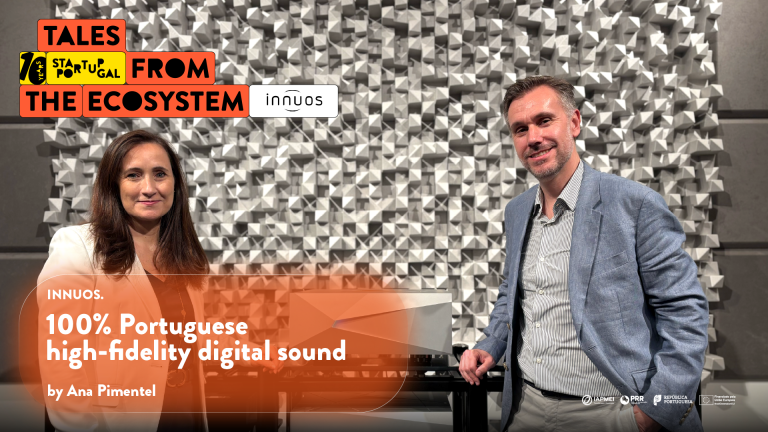
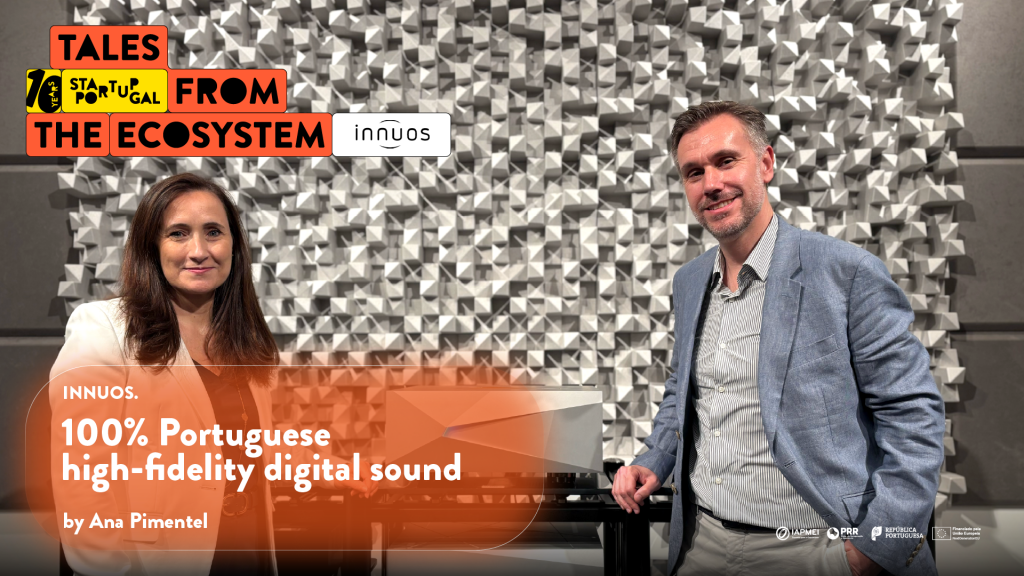
Innuos. 100% Portuguese high-fidelity digital sound
by Ana Pimentel
Innuos’s music servers and streamers have already won more than 100 international awards. Amélia and Nuno turned a passion into a hobby, and the hobby into something close to a utopia.
This content was originally written in Portuguese.
Amélia Santos and Nuno Vitorino are both computer engineers. After working at SAP Portugal, they each set off on international careers. Nuno chose a more technical path, while Amélia built hers in management. From Lisbon they moved to London, where they worked for companies such as Deloitte and Tesco and ended up living for several years. Along the way, Amélia also spent time at SAP Germany and did an MBA at the prestigious French business school INSEAD, in Singapore and Fontainebleau, France. She broadened both her geography and her field of expertise.
In their free time, they listened to music at home, a passion they shared and could enjoy on a good high-fidelity (hi-fi) sound system. There was just one problem: to listen to music at high quality, they needed it in analog form, on CD or vinyl, because at the time we’re talking about (before 2009) there was no equipment on the market that supported digital music in hi-fi. In fact, there wasn’t even a device made just for listening to digital music, the way there were turntables or CD players. Anyone who wanted to listen to it had to turn on a computer or use an MP3 player. Smartphones were still in their early days.
Nuno, who also built things as a hobby, found both solutions in his own hands. He bought a few parts, customized an easy-to-use piece of software, and put together a system that solved the first problem: it centralized all the music they owned in one place and, thanks to an iPod Touch interface, a single tap was all it took to have their songs playing throughout the house. Then he went looking for a way to make those songs sound as good as possible.
“It started with convenience. We wanted to be able to come home, press a button, and have music playing, without waiting for the computer to boot up, and back then they took a while to boot up,” says Amélia, CEO of Innuos. It was at the living room table that Nuno built the device his friends coveted and which, out of curiosity, he decided to put up for sale on eBay. The response was such that in six months he sold 200 of them, all made at that same living room table.
What this first device did was simple: it ripped the CDs inserted into the drive, and the software Nuno had created found the associated metadata, such as the cover art, the artist, and the track names. Within three to five minutes, it was done and the disc came out. These files were joined by digital music from the streaming services that were starting to appear around that time, such as Spotify and Qobuz. “That was one of the big catalysts, the fact that it was very easy to use,” says Nuno, who heads all of the company’s research and development.
With the first problem solved, he moved on to the second: the quality of the sound coming out of the device. How could they raise the quality of what people heard? They began researching and realized that digital sound was affected by several factors, such as how the equipment is powered and the electronic noise inside the system, among others. “And since all of this is at the source, the noise keeps building up. In other words, the signal is amplified along the hi-fi chain. And a noise that seems very small ends up being big by the end and takes away the naturalness of the sound,” Nuno explains. For five years, they worked on this idea in their spare time, but in 2014 they decided to dedicate themselves to it full time, and that took several changes. They quit their jobs and moved back to Portugal.
So, what is this startup all about?
As we talked, in the summer of 2026, Nuno and Amélia put on Sara Bareilles on Innuos’s latest system, the Nazaré. Out of the speakers comes a version of “(Sittin’ On) The Dock of the Bay,” performed live in Atlanta in May 2013. It’s an immersive experience, as if the artist were suddenly there with us, in a private concert, almost singing in our ear. For the signal to be “this pure,” every part of the equipment has to be treated as if it were laboratory material.
“These are high-precision machines that handle the entire signal path with as little noise as possible and the best timing. We use very advanced components, some of them used in the aerospace industry, in Formula 1… These are very advanced materials that help with vibration effects and electromagnetic noise,” Nuno adds. Beyond the hardware, the software is also designed to minimize any loss of sound quality.
When they returned to Portugal, they chose the Algarve to launch Innuos, for industrial licensing reasons. In 2016, when they had a product with an exclusive brand design for the first time, from the chassis to the hardware and software, they launched the brand. From then on, they kept innovating and creating new product ranges.
“I remember that in 2018 we launched a music streamer and server priced at around €5,000, and I decided to do a special edition of just 100 units. That helped me understand whether people were ready to pay a bit more for a product with better sound quality, and whether the market was mature enough for us to keep going for higher price points and invest more in research. And those 100 units sold out very quickly,” Amélia tells us. That’s when they decided to move forward with their top-of-the-range product, the Statement.
In 2019, they launched an integrated app that handled playback, playlist and library management, and streaming services, ripped CDs, and more. All of it was developed from scratch by the Innuos team. The app can be installed on any device and operating system, and each user organizes their library however they like. As with other interfaces of this kind, users can create playlists and add new songs. The difference is that, in the Innuos app, these songs can come from several places, including different streaming services, digital purchases, or CDs converted into digital files.
“I can open the app and see my library in one place. I see my music, and it doesn’t matter where it is. One track is on one service, another is on another, and another on yet another. It doesn’t matter,” Nuno adds.
They also kept investing in sound quality. “The first ranges sounded better than a computer connection, but they weren’t at this level. We kept investing in research and isolation, in both electronics and software, to understand how we could improve sound quality in a device like this, because that knowledge didn’t exist on the market,” the scaleup’s CEO adds.
The products grew and improved over the years and, in 2025, they introduced the Nazaré to the world. “We’re getting closer and closer to what might be the utopia of tricking our brain into thinking there’s a band playing in our own space,” says Nuno.
At the time of our conversation, Innuos had three product series on sale, Stream, Zen Next Gen, and Nazaré, in more than 200 specialist stores in 52 countries. Entry-level equipment cost around €2,800 and the top of the range €90,000, and could only be bought in physical stores.
“We innovated in a lot of things, not just the product, but also the way we distribute it. We realized very quickly that many distributors didn’t understand this category, and we felt the need to be closer to the store and the end consumer. So we decided to handle distribution ourselves in most markets. We only have seven distributors, in countries where there’s no other way to work,” says Amélia. Among the largest markets are the US, England, China, and Germany, and the CEO believes Japan, one of the most recent, will reach the top five within a year or two.
So who are these products for? For people who “love listening to music. It’s as simple as that. They’re audiophiles, typically,” says Amélia.
From idea to reality: what does it take?
In ten years of Innuos, Amélia and Nuno have never turned to investors. They used their own capital and bootstrapped, growing as revenue grew. “Wanting to create a premium brand in a category people didn’t understand, because it was still being created, I realized early on that it didn’t make sense to seek outside investment. And to this day we don’t have any, because our outlook is long term and about building a consumer brand,” says Amélia.
When they came back to their home country, the first person they hired was a designer. For Amélia, building a brand was essential, something the entrepreneur would like to see happen more in Portugal. But she didn’t want just any brand, she wanted a premium one. “We don’t have the scale in this country to do things in volume, but we have a lot of know-how, very good engineers, a technical capability that was one of the things that made us want to come to Portugal. We have that capability in the country in terms of resources,” she says.
Although she acknowledges that building a premium brand in Portugal is a hard road, especially in a product category that doesn’t exist yet, Amélia didn’t give up. She focused on quality, consistency, and building credibility, “things you can’t speed up,” she says. “And we did it, in spite of everything, very quickly. Innuos is ten years old, we’re in 52 markets, and the Nazaré is considered the international benchmark streamer for sound quality and ease of use,” she adds.
With more than 100 international awards, the Portuguese scaleup is betting everything on the resources it has in-house. Next to the people sitting in the office in Faro is the door to the lab where every part is produced; then come the doors to packaging, quality control, customer support, and distribution. Everything is done by a team that now numbers around 50 people of 13 nationalities, some hired in their home countries who changed their lives to work at Innuos. Only this way could they achieve the brand quality they were aiming for, Amélia tells us, “thought out down to the detail” regardless of the product.
“We started this out of a passion for listening to music. We tried to solve a problem that, at the time, we never dreamed would lead us here,” the head of the Portuguese brand tells us. “Hi-fi was one of the things we always had at home. In practice, it’s for people who like to sit down and listen to music. I think that’s the big difference: it’s for people who like to sit down and have that experience of almost a private concert at home,” she adds.
Beyond the awards its products have won, in 2018 Amélia was recognized by the European Commission with the Digital4Her award, and Forbes included her in its list of 100 Women Founders in Europe to Follow. In 2019, she was a finalist for the João Vasconcelos Award for Entrepreneur of the Year. As of our conversation, Amélia and Nuno were still the company’s only shareholders. All because they loved listening to music.
ABOUT TALES FROM THE ECOSYSTEM
Every startup begins with a person and a problem they couldn’t ignore. In Tales From The Ecosystem, we ask Portuguese founders two questions: what is this startup, really? And what did it take to get from idea to reality? The answers take us from the first spark to the business model, the funding rounds and the markets still ahead, in their own words.

Other blog posts