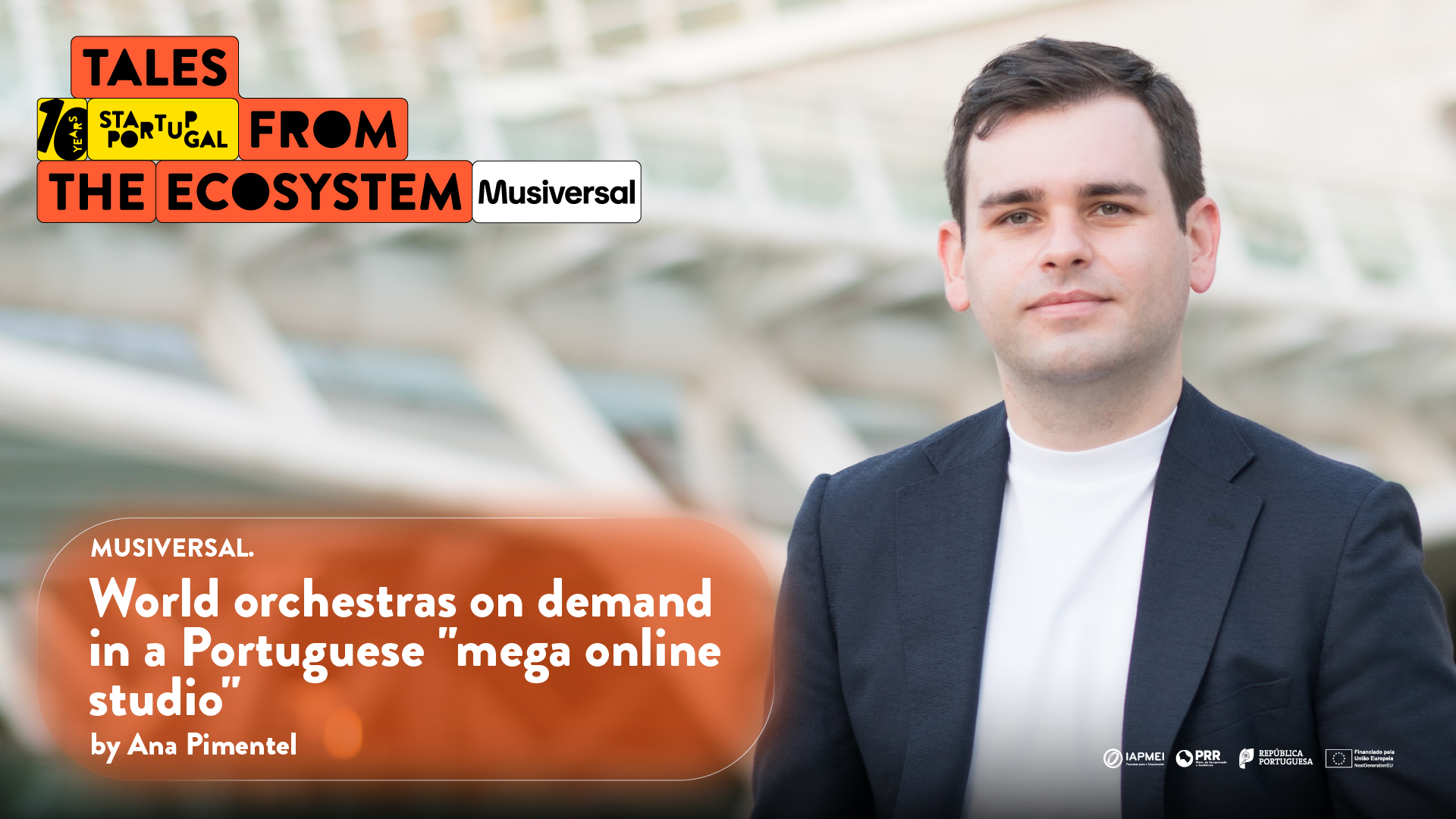
Musiversal. World orchestras on demand in a Portuguese “mega online studio”
November 12, 2026
by Ana Pimentel
His passion for music took him to the US, and it was at the heart of the film industry that he created a pioneering remote music recording service. All so that music production would be just a click away.
This content was originally written in Portuguese.
He always wanted to be a musician, but not the kind of professional musician we traditionally imagine: in concerts, on a stage, with a violin. For André Miranda, CEO and founder of Musiversal, a music production platform, the dream was something else: to be an executive producer and film score composer. Geographically (because that was the only way he could make the dream come true), there was room for only one country, the one on the other side of the Atlantic that rules the film industry: the US. And that’s where he packed his bags for in 2010. Next stop: New York City.
“The US has a very large entertainment and music sector, the film industry, so being a musician there, in that industry, feels different from being a musician here [in Portugal]. It’s very different. And I wanted to be part of that industry. At the time, that’s what I knew, nothing else,” he tells us.
Although all his training was in music (first at the Conservatório Nacional, where he learned the violin, and then a degree in Composition at the Escola Superior de Música), André always wanted to go beyond making art. Perhaps that’s why he fed his more “nerdy” side, as he calls it, along the way. How? By studying mathematics. While working through fractions and equations, he kept writing his own pieces, his own compositions. Two worlds that came together on the way to the same destination.
Once his compositions were finished, he would summon his courage and move on to the next stage: getting his work in front of the people who mattered. “Since composing alone wasn’t enough for me, I chased conductors from several Portuguese orchestras,” he recalls, laughing, “and asked them to play my music in concerts. I managed to convince a few, tried out a lot of things, and built an interesting portfolio.” Little did André know that this was also the start of his path as an entrepreneur.
It was with this portfolio that he applied for a scholarship from the Calouste Gulbenkian Foundation. And the “luck” of getting it is what led him to say “see you soon” to family and friends and go study Film Scoring at the prestigious New York University. “I only went because I had a full scholarship, otherwise it wouldn’t have been possible. This university is super expensive, it costs a lot of money, and, well, I was lucky to get the scholarship,” he explains. Perhaps it’s thanks to that scholarship that Musiversal exists today.
After a master’s degree in the field that had fueled his teenage dreams, a doctorate followed at the same American university. First, he did the Advanced Certificate program in music business: he spent half his academic time at the school he had joined, and the other half at Stern [NYU Stern School of Business]. “As you can see, the two things came together later when I created Musiversal,” he says. In truth, they had already started coming together in his teenage years.
With his studies behind him, it was time for the next step: entering the job market. He started working in the field he loved, film scores, as a freelance executive producer. Essentially, he was an intermediary: on one side were industry clients who needed to record soundtracks, and on the other were orchestras. With the scores and references clients gave him, André found musicians available to go into the studio and record what was needed. And that studio could be anywhere in the world.
Once orchestra and client were matched, André recorded the soundtrack and delivered the master file to the production. “I pioneered a remote music recording format called Shared Recording Sessions, which cost just $99,” he says. After that, it was anyone’s guess: the recording might or might not be used, but by then that no longer mattered to him.
So, what is this startup all about?
Working as a freelancer made André realize the scale of the financial problem artists were facing. The model, the way the work was set up, made it hard for them to access higher earnings. So a way had to be found to cut the cost of music production, make it more efficient, and make it available online to anyone. How could he help?
The solution he came up with, the Shared Recording Sessions, won over the industry, and the Portuguese musician’s work began gaining traction online. So much traction that it became more than a freelance project and turned into a startup. “Musiversal is a massive expansion of this business model,” he says. And it happened organically, as a result of good work, not out of an ambition to build a big company, the entrepreneur explains.
Looking back, André recognizes that at the time (this was 2018) there was a big disconnect between musicians and the online job market. It was wasted talent. He concluded that what was missing was a company acting as an intermediary between the industry’s different players: one that organized musicians and music production services so they were easy to get online.
That was the year he returned to Portugal, after also spending time in Los Angeles, and rolled up his sleeves. But he had no illusions: the entrepreneur knew he faced a big challenge in logistics and in building the platform with a live streaming service.
Still, he also knew a tool like this “could potentially create hundreds of jobs for musicians and make it possible to create millions of music tracks.” Computer-made mockups would give way to real musicians. “I started there and it worked, in the sense that it gained commercial traction, because people recognized the same problem. So it started to grow,” he says.
From idea to reality: what does it take?
With the industry’s problem identified and a technological solution in place, a business model was needed. And André Miranda didn’t hold back: he created a monthly subscription that gives clients access to the pool of musicians registered on the platform and unlimited sessions with them, at no extra cost.
“Musiversal has a completely pioneering business model, no other company has the same model. In music there’s absolutely none, so we had to run a huge number of experiments and bang our heads against the wall to figure out how this could work,” he reveals.
After creating the business model, he looked for the best way to reach profitability and positive margins. On the way there, he realized he needed a very clear picture of each user’s average usage rate, which instruments they were looking for, whether the platform had a recording slot available close to the date the client wanted, and whether all of this could happen with a positive profit margin.
Based on this research, he made some changes to the original model: the price went up, and the team had to get smarter about matching what clients really needed with the musicians on the platform. All to keep the process efficient and make sure there weren’t too many unused sessions. “It wasn’t easy, it wasn’t working well, it took time, but today it finally works.”
For artists, a platform like Musiversal was a game changer: suddenly they had another source of income, one they could work on from home, at whatever hours suited them best. When we spoke, in the summer of 2026, Musiversal had more than 120 musicians on the platform, doing roughly 10,000 sessions a month. “That’s really a lot, it’s a mega online studio,” he says. In total, the platform had already passed 200,000 sessions. In sales terms, that’s more than 5 million in annual revenue, almost 100% of it from the US.
Looking ahead, André Miranda wants to keep growing, scale the business model, and have more happening on the platform. “When I was billing €100,000 a year, I thought reaching a million was an unattainable goal, but it happened, and then going from one to two million was a much smaller step. I think a founder always has the ambition to take the company as far as possible.” In the summer of 2026, more than 30 people worked at the startup, some in Portugal, others elsewhere in the world.
Getting here required raising capital. When we spoke, $10 million had already been invested in Musiversal, mostly from Portuguese funds that believed in the company’s vision and have kept investing in subsequent rounds since the beginning, the founder explains. Investors include venture capital firms Shilling Capital Partners, Lince Capital, and Iberis Capital.
Despite the growth and the innovation in both product and business model, André Miranda admits that, looking back, he regrets having managed more conservatively in the early years. “I should have taken more risks and made decisions much faster, because if I had, Musiversal would be three times bigger. Every month that goes by without making the right decisions affects the future. That’s the only thing about the past that frustrates me,” he recalls.
As for being based in Portugal while doing business in the US, he says it doesn’t really matter where he is. In the American business mindset, he explains, location isn’t an issue. “I don’t think being Portuguese or American makes a difference. Both have exactly the same ability to make things happen, it’s exactly the same.” The same goes for the artists, down to the last detail. And that’s why Musiversal is revolutionary: it puts professional musicians a click away, wherever they are. All with Portuguese technology.
ABOUT TALES FROM THE ECOSYSTEM
Every startup begins with a person and a problem they couldn’t ignore. In Tales From The Ecosystem, we ask Portuguese founders two questions: what is this startup, really? And what did it take to get from idea to reality? The answers take us from the first spark to the business model, the funding rounds and the markets still ahead, in their own words.