iLoF. The fingerprint that wants to revolutionize personalized medicine
November 25, 2026
by Ana Pimentel
It brings together photonics, artificial intelligence, and healthcare professionals to build a digital library of disease biomarkers. The goal: to help find and develop the right drugs for each patient.
This content was originally written in Portuguese.
He’s an engineer by training, but he wanted to be an entrepreneur from early on. Behind that wish was his grandfather, a “self-made man,” as Luís Valente calls him, who was born in the 1930s and had a “huge impact” on how he grew up. “I was always fascinated by the idea of zero to one, meaning taking something that doesn’t exist, building it from scratch, replicating it, and moving on to the next thing,” the iLoF CEO tells us in one of the meeting rooms the digital health startup occupies in the Founders Founders building in Porto.
With entrepreneurship running in his blood, it was clear his path would involve founding his own companies. “Designing, really understanding the problem, and trying to create a solution for that specific problem is something I get a huge kick out of,” he says. So he started working early, “very early.”
First, around 2008, he had a small company that built platforms to automate e-commerce, where he stayed for about five years. He then moved into commodities, and when the chance came up to work with a technology institute in Porto, INESC TEC, “which was bringing several technologies to market, new things,” he didn’t hesitate and joined. That’s how he made his debut in the startup world.
First stop: Veniam, where he “learned an enormous amount” and worked directly with CEO João Barros, without losing touch with the teams he had met at the institute. At one point, they called him: there had been a “technological breakthrough” in one of the projects, and they wanted to know if he’d be interested in joining them on an international acceleration program.
When they explained in more detail what it was about, a technology capable of helping capture massive amounts of data to accelerate personalized medicine, Luís Valente had no doubts: “I fell in love, not with the technology, but with the problem the technology could solve,” he says. That’s when he met Professor Paula Sampaio and researcher Meh Mumtaz, with whom he would go on to cofound iLoF.
For six months, the entrepreneur juggled his full-time job at Veniam with an international acceleration program in Boston, in the US. During that period, they conducted 120 documented interviews, and it became clear to the team that the problem they were trying to solve was real. And what was the problem? Tailoring treatments to each patient’s specific reality.
“The way drugs are made today is very similar to the way they were made 100 years ago. You develop a new molecule and test it on a patient. It doesn’t work, you test it on another. It doesn’t work, you shelve it. It’s very hard to tell whether a drug that doesn’t work on patients one and two might work on patient three,” he explains. He uses everyday examples to illustrate: “It’s like buying a T-shirt. If we’re a size S and we try on an XL that’s too big, we don’t say the T-shirt is broken, we try another size. In medicine, that doesn’t happen,” the CEO adds.
The technology sparked so much interest that, by the end of the program, they had 10 letters of intent from companies that wanted to work with them (three were big pharma companies) and two investment offers, one from a US investor and the other from a German public-private consortium. They chose the Germans, and with that, the company’s first €2 million came in.
When the term sheet was put on the table, Luís Valente went to speak with João Barros and told him he was going to accept it, which meant the end of his time at Veniam and a return to life as an entrepreneur. And in early 2020, iLoF began operating: first in Oxford, in the UK, and then in Porto.
So, what is this startup all about?
The passion for the problem was there, and so was investor interest, along with technical talent and what’s known as Freedom to Operate, meaning they had assurance they could develop their technology without infringing on third-party Intellectual Property rights. The die was cast for the cofounding team.
After those first 120 interviews, they realized the drug development problem is most severe in neurodegenerative diseases such as Alzheimer’s, so that’s where they chose to start their path into personalized medicine. But how does iLoF’s technology work? It operates at the intersection of three fields: artificial intelligence, optics, and biology.
“In an ideal world, we’d have a magic camera we could use to take a picture of cells, of blood, and digitize the information contained in those cells. But that doesn’t happen. Clinical tests are mostly chemical; we can’t take a picture of blood and understand its components,” Luís says. Instead of a two-dimensional image, what iLoF’s technology captures is a signal: it shines a beam of light, digitizes the nanoscopic composition of the sample, and that signal is used to train artificial intelligence models. Based on these patterns, the models can tell whether a given patient is a good “fit” for a specific drug.
“Obviously, right now there’s a focus on drug development and discovery. Once we can distinguish between two types of patients in a clinical trial, we can also do it in the clinic,” the cofounder explains.
The first test came with the Covid-19 pandemic, through a study carried out with the Oxford AI Clinical Lab and Hospital de São João. The goal: to distinguish the profile of a patient who might end up in Intensive Care from one who would have milder symptoms. At the time, they created a model, backed by the European Commission, “that could predict this with 85% certainty, 15 days in advance.”
“Fortunately, the vaccines saved the day,” and there was no need to roll out the model on a large scale. But it didn’t go to waste: today it’s still the basis for several iLoF products.
To train the models that will help with this kind of screening, iLoF needs access to large amounts of data and to build a digital library of disease biomarkers. It gets this data through partnerships with biobanks or by placing its data collection platforms in hospitals. In Portugal alone, it has partnerships with more than 10 hospitals, but the Portuguese technology’s reach goes beyond borders: the UK, the US, Australia, Spain.
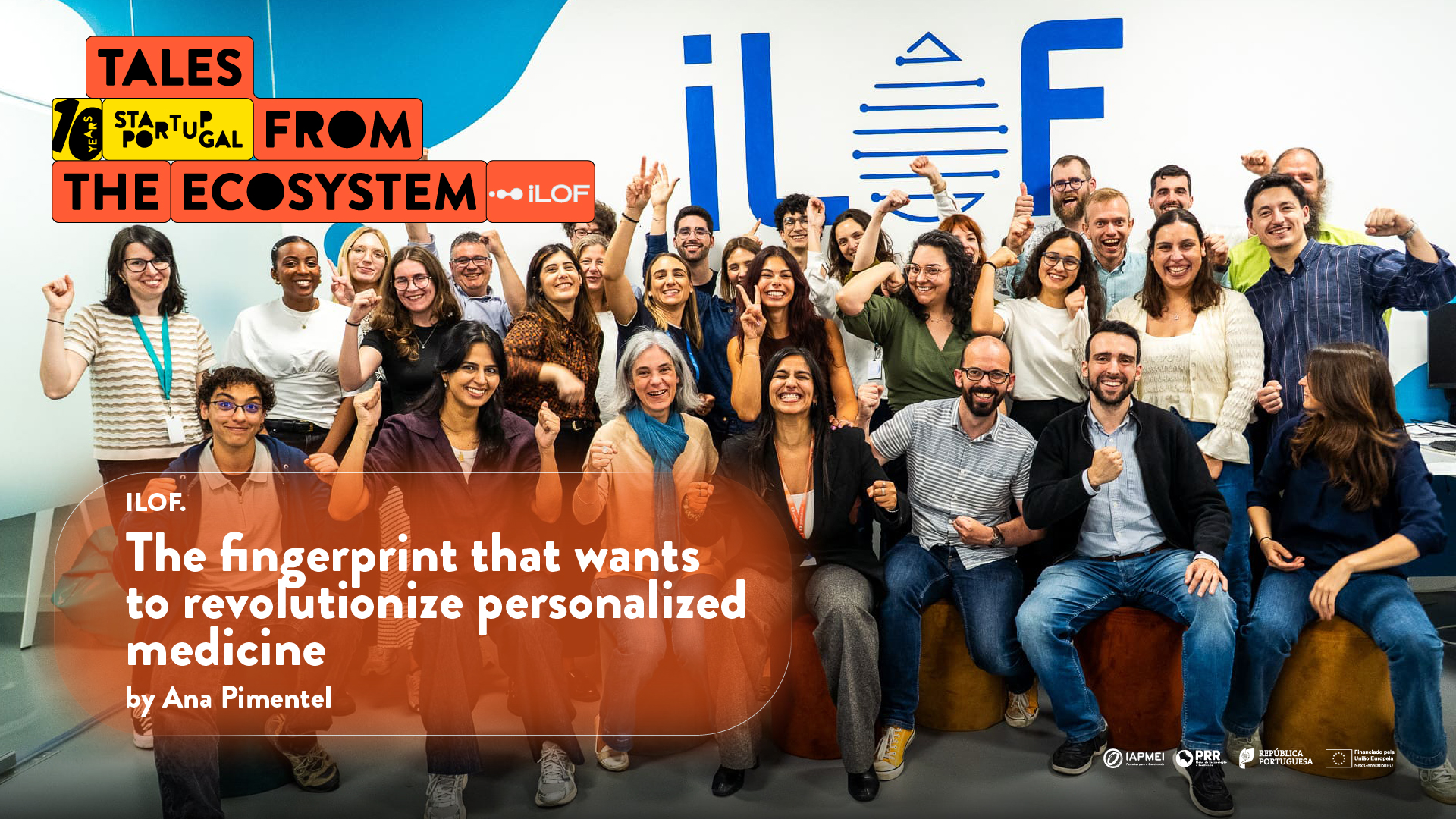
On the operations side, when we spoke in the summer of 2026, iLoF had teams in the UK, Porto, and Lisbon, as well as a few people in the US. In total, it had around 40 employees. It was also trying to enter the Japanese market, with the help of its partner Hamamatsu Photonics, since Japan is one of the Portuguese startup’s key markets: “It has one of the oldest populations and one of the highest rates of Alzheimer’s,” the CEO says.
From idea to reality: what does it take?
During its first years of activity, the team focused on technology development. “It’s a long road,” says Luís Valente. To move forward, the cofounders set up partnerships with large companies operating in the startup’s three fields: photonics, artificial intelligence, and healthcare. As for investors, they also realized these had to be aligned with the needs of a deep tech company like iLoF, with a realistic sense of how long this development could take. And, of course, they needed “a lot of capital.”
From 2020 to 2026, iLoF raised around €20 million in investment. “We hadn’t even closed the initial €2 million and I was already out there trying to figure out how we’d close the next round,” Luís says. It helped that the startup was incubated at the Oxford Foundry, a University of Oxford incubator, which gave them exposure to a global ecosystem of partners, investors, and talent. That’s how they caught the attention of investors such as Mayfield and Microsoft. In mid-2022, they closed a €5 million round.
In total, over six years, they raised around €12 million from private investors. On top of that, they had access to non-dilutive European funding and also received support from the EIC Accelerator, the European Innovation Council’s instrument focused on deep tech startups. With this capital, they were able to build several verticals and develop the technology.
“The platform is growing, gaining value, and getting stronger so it can grow commercially in other geographies,” he says. In neurodegenerative diseases, iLoF took part in a study with more than 20 clinical centers in the United States, Canada, and the UK. In the lung cancer vertical, “one of the biggest silent killers worldwide” and another of the startup’s main focus areas, they’re relying heavily on partners in Germany, Portugal (where they already work with some hospitals), and the UK.
When we spoke, the goal was for the company to make a leap in growth within about 18 months, allowing it to use the technology to tackle more problems and more diseases. “One measure of success for us would be contributing directly to the approval of a drug for one of the diseases we’re working on, a drug that otherwise might not even have been approved, because it was tested on the wrong people,” the CEO adds.
But the cofounders don’t want to stop there. iLoF’s big medium-term vision, “because it requires a lot of capital and data,” is to enable personalized biological profiles for each person. The goal: to test the same patient over time, tracking the differences and changes that occur.
“It’s not about the normal conditions, aging, but about what deviates from the normal pattern. Being able to predict, before a disease sets in, based on eating or behavioral habits, that someone is on a path toward a higher likelihood of disease. You can only do this with a fingerprint, a digital twin of each person,” he concludes. It may sound dystopian, but for iLoF, the dream is for this twin to become reality.
ABOUT TALES FROM THE ECOSYSTEM
Every startup begins with a person and a problem they couldn’t ignore. In Tales From The Ecosystem, we ask Portuguese founders two questions: what is this startup, really? And what did it take to get from idea to reality? The answers take us from the first spark to the business model, the funding rounds and the markets still ahead, in their own words.