OneShot. The assistant that wants to solve recruiters’ pain points
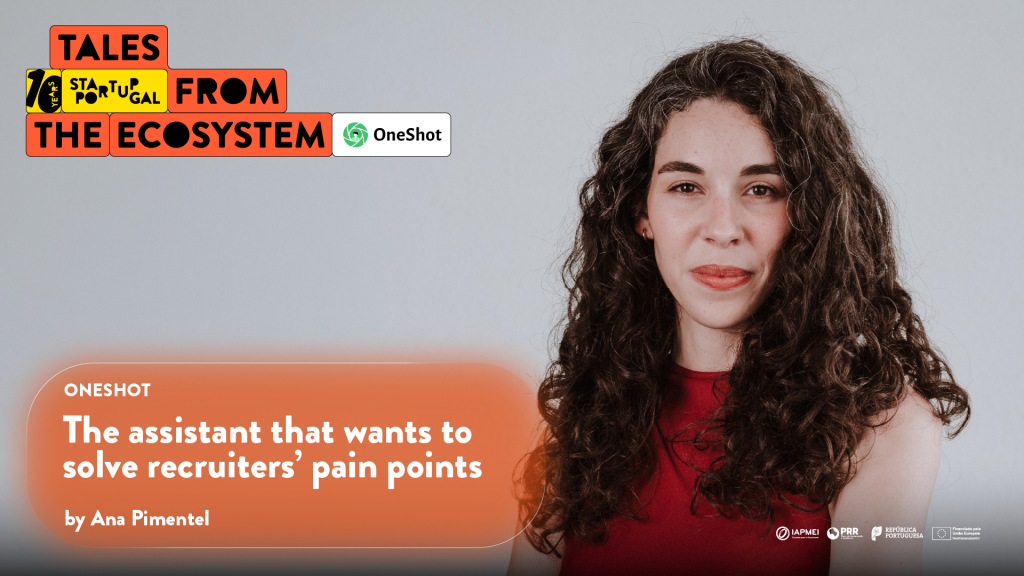
by Ana Pimentel
She’s a biologist, programmer, competitive swimmer, and entrepreneur. Ana Neto knew she wanted a business of her own and didn’t stop until she had built the artificial intelligence that helps companies hire.
This content was originally written in Portuguese.
Ana Neto was a competitive athlete for 15 years. She started swimming at five and only stopped at 22. She set national records, swam for the Portuguese national team, and grew up used to long hours of training, which she had to balance with school and the typical social life of a teenager. “I think it gave me a sense of discipline and organization that lets me get a lot done in an hour. And that’s very much the foundation of who I am,” she tells us.
Her upbringing steered her toward the sciences, and at university she chose to study Biology. When we spoke, she admitted it isn’t the field she most identifies with, which later led her to explore more artistic pursuits: she took singing lessons and has a rock band, so you can also find her on stage giving a concert. Along the way, between all her interests and challenges, she created OneShot, a tech startup that uses artificial intelligence in recruitment, which she runs on her own. “I really like being challenged, growing, and seeing myself go beyond my own limits,” she says.
So it’s no surprise that Ana chose to become an entrepreneur. She likes having the autonomy and freedom to deal with problems and solutions, something that would be hard to find on a more traditional path. For a long time, she wasn’t sure where to start. She studied Biology but never worked in the field. Instead, she joined a marketing agency and began teaching herself to code. Her path started to run through technology, and then came the epiphany: “If I want to be an entrepreneur, it makes total sense to have a skill that adapts to any kind of business.” Programming gave her that versatility.
She worked at several companies, startups, and small agencies, and in 2019 she took the risk and opened a software agency, which she ran for five years. Having her own agency came close to the dream, but something was still missing: Ana wanted a product of her own, something she could build from scratch and grow. So she decided to take a break and do an MBA. “I started listening, paying attention to what people around me were saying, looking for a problem to solve,” she says.
One of Ana’s MBA classmates wanted to hire a junior for his startup but couldn’t manage it alone. He asked her to help with the job posting and selection process, and within two days they had 300 applicants. “We had to read between the lines to figure out who had the right attitude, because it was a startup and it needed someone really eager to learn. And I found myself trying to see how they thought, whether they had other projects, whether they’d done other things at university, I don’t know. And I think that’s when I started thinking there had to be a better way to do it.”
She thought it over, and found one. OneShot is the project through which Ana Neto wants to solve employers’ early-stage challenges. Among hundreds of applications, how can they quickly pre-screen who might be a good fit for the role or company? Recruiters need at least five minutes with candidates, talking to them or seeing them on video, to get some extra information, Ana concluded. But in the traditional format, that isn’t feasible. Could a tech product solve this? Yes, with the right AI assistant.
So, what is this startup all about?
At OneShot, the whole process starts with a conversation between the recruiter and the AI assistant Ana Neto built, which tries to understand as fully as possible the context of the role and the kind of person or profile the company wants to hire. Once all the necessary information is gathered, the assistant moves on to the second phase: it prepares a challenge, a set of questions that will be presented to candidates on video. At this stage, the recruiter can step in and ask the AI assistant to change the questions or give it other instructions.
Once the challenge is finalized, the assistant generates a link that is sent to candidates, who then answer the questions out loud. At the time of our conversation, the platform only captured audio, but the idea is for it to capture video as well. When the challenge is over, another AI cross-references the information the recruiter provided about the role with the candidates’ answers. Finally, it scores each candidate (everyone applying for the same job is assessed on the same set of dimensions) and generates a report that it sends to the recruiter.
The interface where the challenge takes place looks a lot like those of the most common video conferencing tools, but instead of a face, the candidate sees a question on the screen. “We don’t have an agent talking to the person, it’s asynchronous. And that was a deliberate decision, so people aren’t talking to an AI. The candidate sees one question at a time and answers out loud, as if they were thinking out loud,” the entrepreneur explains.
The fact that the startup only captures audio isn’t by chance either. The goal is to prevent candidates from being selected for reasons unrelated to their answers. Using only audio helps recruiters work solely with the text-based information they receive. “In our analysis, we remove as much as possible that could identify the candidate: their appearance, gender, whatever it may be. And we’ve had good results with that, we help counter some of the biases that may exist,” the founder says.
Once the reports with candidate scores are delivered to recruiters, OneShot’s job is done. From there, recruiters handle the next phase: they run the interviews and make the decision. “Our report also ends up acting as an interview guide, because you can already see in the report whether a person is very strong in one area but less so in another,” she adds.
To make all this work, Ana Neto created several job categories, such as tech, marketing, and sales, among others. This allowed her to build a database of useful questions, and she also uses feedback from the pilot tests she’s been running to keep fine-tuning the algorithm. “The questions are increasingly tailored to each person,” she says. On top of that comes the feedback she receives from recruiters.
Although the core of the business is focused on companies (they’re the ones who hire OneShot to help with recruitment), the entrepreneur has also thought about people looking for new professional challenges. For candidates, the startup offers three tools. The first lets them match their CV against the job they’re applying for, with the platform giving feedback on missing skills and suggestions for improvement. The second and third focus more on interview preparation: one for the HR interview (where the candidate has to talk a little about themselves and their background), and one that assesses the candidate from a more technical-skills perspective. In the summer of 2026, these two services were free, but Ana was planning changes: “We’ll probably offer some of these tools for free, or offer the first attempt and then, for more attempts or feedback, add a small subscription,” she adds.
At first, the focus was mainly on startups, because by nature they have smaller teams to handle large volumes of applications. She started with a small subscription model but soon realized that wasn’t the way to go. She moved on to scaleups and recruitment agencies, which already have much more volume and capacity to give feedback.
From idea to reality: what does it take?
When we spoke, Ana was running the startup on her own. She built the product, launched the company, and handled all the business contacts. For a while, she worked alongside a co-founder, but it was temporary. She went back to being a solopreneur, although she was in talks with another startup about a possible partnership.
Besides being the face, mind, and voice of OneShot, the entrepreneur still works as a freelance programmer, and she’s the one investing in her startup. How does she fund it? With her own capital, from what she earns on other work. “I’d like to be able to bootstrap. For me, investment only makes sense if it’s strategic, from someone who has contacts or knowledge in the field,” she says.
For the founder, the focus wasn’t on finding investors but on finding someone for the team who could take on business development, communication, and sales. The more solitary path she’s been on made her realize that what she does really well is build, and that everything involved in communicating and going to market is very challenging. “I’d really like to have a team and find a co-founder. From my experience, I believe it’s something that has to be done calmly and carefully, because it’s a relationship that, if it goes well, will last a long time, and there has to be good alignment.”
When we spoke, OneShot was testing its tools across several projects. First with startups, then with scaleups, and “in the middle of all this,” it found a 500-person recruitment agency in the Philippines, with which it is running a pilot. “And that’s where we’ve been aiming a bit lately, at recruitment agencies, but in Portugal it hasn’t been easy, there’s a lot of resistance to modernization in HR,” she says. That’s why she turned to English-speaking markets elsewhere in Europe.
“For me, OneShot is an idea I like and want to develop, but what I really wanted was to enter this world and start learning. And we only learn by doing. I spent so many years of my life preparing, thinking, and I just want to get in. I want to take OneShot as far as possible and learn as much as I can,” concludes the biologist, autodidact, programmer, swimmer, and rock band singer. And entrepreneur, above all, entrepreneur.
ABOUT TALES FROM THE ECOSYSTEM
Every startup begins with a person and a problem they couldn’t ignore. In Tales From The Ecosystem, we ask Portuguese founders two questions: what is this startup, really? And what did it take to get from idea to reality? The answers take us from the first spark to the business model, the funding rounds and the markets still ahead, in their own words.

Other blog posts