Surf REC. The Portuguese startup that caught the attention of one of Elon Musk’s cousins
November 5, 2026
by Ana Pimentel
Afonso Maya and José Ribeiro Ferreira created an automated wave-filming system that will give amateur surfers access to online coaching. Here’s their story.
This content was originally written in Portuguese.
Afonso Maya wanted to be a pilot. He comes from the family with the most generations of pilots in the world, started flying at 17, and by 21 was ready to apply for a position at TAP. But a change in regulations threw his plans off course: a color vision problem closed the door on a career on board aircraft. From then on, he did a bit of everything and worked in several fields, but one thing stayed constant throughout his life: surfing.
The founder of Surf REC, a Portuguese startup that wants to revolutionize video analysis and training for surfers, started surfing at 13, at Carcavelos Beach. In his early 40s, he realized he had worked in almost every field except the one he loved most and where he knew the most people. Once the seed of that thought was planted, there was no stopping it from growing. In 2013, he decided he wanted to create a solution to a problem surfers had, and that this would be his new professional life.
The idea came to him while he was cooking: what could he do to help amateur surfers like himself improve their technique? Around this time, video analysis was gaining ground in several sports, and surfing was no exception. By watching themselves surf, professional athletes (and their coaches) could see what they were doing right, what they were doing wrong, and where they could improve. But amateurs, for various reasons, rarely saw themselves surfing and reached a point where they couldn’t progress any further.
To get around this, Afonso began testing ideas. First, he created a filming service, Camera Boy, and went to the beach to film amateur surfers, but the challenges he ran into made him realize that wasn’t the way forward. In 2021, he had his “second epiphany”: if he created an automated filming system, some of the constraints he had identified would be solved. That’s when Paulo Alvito, who has extensive experience in robotics, joined the project as co-founder and started developing a solution to automate wave filming.
While all this was happening, José Ribeiro Ferreira was surfing professionally and kept crossing paths with Afonso at the beach. “Zé,” as his friend calls him, competed in national and international surfing events from age 10 to 26, and so had direct access to specialized coaches, footage of his waves, and constant technical feedback. He was on the other side of the fence, and the difference in how their surfing had progressed was clear. When Zé left competition, he co-founded Wave by Wave, a nonprofit association that delivered surf-based therapeutic intervention for at-risk children and young people. After that, he went on to study Management at Nova SBE.
In 2023, the future CEO of Surf REC got the phone call that would change his plans: Afonso Maya wanted his help with a question about associations, and when Afonso told him about the project he was working on, Zé knew he had to be part of it. It all made sense. “It’s simple, it’s basic: you get filmed by a robot, take the footage, and analyze it with a coach. This is going to be the future,” he tells us. Afonso adds: “I was always looking for a CEO. Founders are almost always the CEO, but I think that trend is often disastrous.” All it took was the right phone call to find someone to run the project.
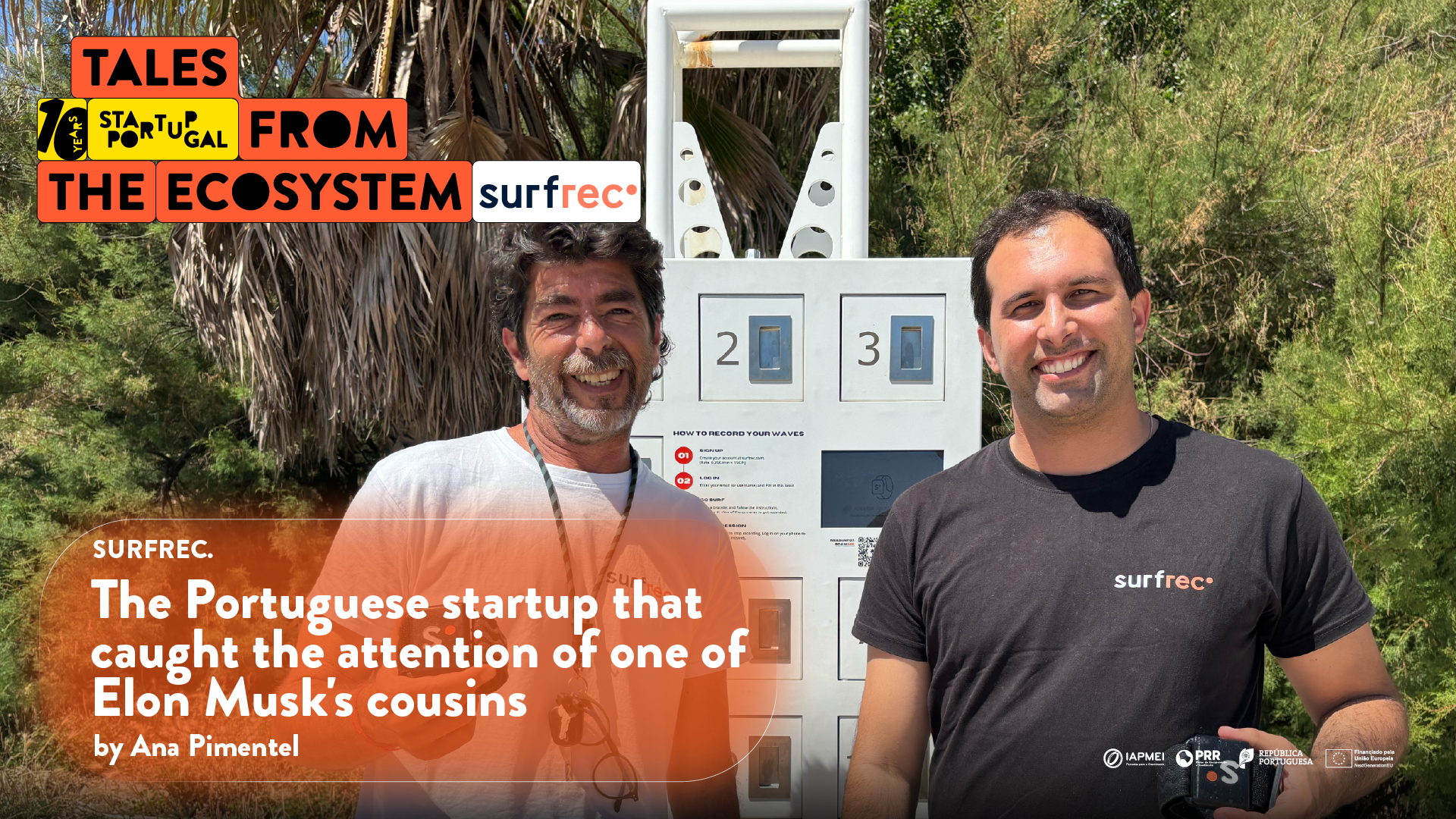
When we spoke in the summer of 2026, at Carcavelos Beach, Surf REC was already a reality. Next to us stood the kiosk with the filming cameras and the lockers holding the wristbands. Surfers already had access, on their phones, to the platform with footage of everyone surfing that beach. And on TikTok, a post by a Brazilian guy who works at a restaurant on Carcavelos Beach, filming the kiosk, had gone viral and flooded the founders’ inbox with requests from around the world.
So, what is this startup all about?
Through its footage, Surf REC wants to bring online coaching to all wave sports: the athlete is on the couch, on a call with their coach, getting feedback based on the footage they received on their phone. For that to happen, three things are needed: robotic cameras, GPS-enabled wristbands that track the surfer, and a tech platform where users can access their videos and coaches.
First, they had to overcome the robotic camera challenge. “We had to develop a system that could consistently track surfers in the water, with and without light, with big waves and small ones, at high tide and low tide, and that was consistent. That was our first big challenge,” the CEO says.
In the summer of 2026, anyone surfing at Carcavelos Beach or Ribeira d’Ilhas, in Ericeira, could already access their footage. They would go to the Surf REC kiosk and create a user account on the tablet there for that purpose, the door of one of the lockers would open automatically, and the surfer would take out the wristband to wear while in the water, with no time limit. When they finished, they returned the wristband to the locker and, two minutes later, the footage would be in their user account, on their phone. The service cost €0.25 per minute / €15 per hour.
With the videos in hand, athletes could take them to a coach of their choice for feedback. At the time of our conversation, the team was developing the platform where coaches could sign up to train surfers remotely, based on the videos. In essence, it’s an online coaching marketplace, whose mission also includes broadening the income sources of people who make a living from surf coaching, since they’re no longer tied to a single beach. “A coach in Carcavelos can have a client base in France or South Africa,” they explain.
But the ambition doesn’t stop there. “We have a great data source, because we have proprietary technology and a lot of videos. Now we want to turn these videos into quantifiable data and teach a machine learning system what a paddle stroke is, what a right-hand wave is, what a barrel is, and so on. […] This is the third layer of our business, turning data into sports insights, and it’s already underway. It’s a trend across many sports, and we’re leading that movement in surfing,” explains CEO José Ferreira.
The kiosks at Carcavelos and Ribeira d’Ilhas have 16 lockers and six cameras. Each camera is dedicated to tracking one wristband, but the idea is that in the future it will be able to track two different wristbands, allowing 12 simultaneous recordings on the same beach. The next step is to install eight more kiosks on beaches in other parts of Portugal, and then they want to move ahead with a franchising model. “We already have a lot of interest, both national and international. The other day, a Brazilian kid came by [the Carcavelos kiosk], made a TikTok of the kiosk, and we got 50 emails from 50 people in 15 different countries asking us to expand,” the CEO reveals.
From idea to reality: what does it take?
When Zé joined the co-founding team in 2023, both he and Afonso still had other jobs and worked on Surf REC on the side, in their free time. Once they had a camera prototype they were happy with and that proved the business thesis, they went looking for investors. They spoke with several business angels until they landed on the four who had “the courage to invest in their startup,” they say: two Portuguese, one French, and one American.
They reached the American investor through Frenchman Arthur Moreno. On the day of the meeting, they showed up at the office without knowing exactly who they’d be meeting, and the potential investor appeared “with a long beard, in flip-flops and shorts, looking like a bit of an outsider, super interested in the pitch. He was the one who asked the most questions,” the co-founders recall. Then, at the end of the meeting, Arthur Moreno told them who he was: Peter Rive, co-founder of SolarCity and Elon Musk’s cousin. In 2016, SolarCity was acquired by Tesla for $2.6 billion.
Peter Rive’s questions and interest were no coincidence, and the entrepreneurs managed to close the investment. The round, in 2024, brought in €165,000, which they used to build the software infrastructure, set up the filming and smart locker systems, and bring the fourth co-founder, Maeva Plasse, onto the team. The lockers were made by a Portuguese metalworking company in Aveiro, the robotics were developed with the team at IDMind, another of Paulo Alvito’s companies, and the software was outsourced.
At the time of our conversation, Surf REC was trying to close another investment round of €600,000. The founders already had 70% of that amount secured through a fund, but were still short about €200,000. “We’re looking for business angels who can bring strategic resources, people with vision and institutional contacts, and if they have a connection to surfing, even better,” the CEO explains.
The round will go toward rolling out the sales strategy with surfers, but also with businesses such as surf schools and hotels that want a Surf REC kiosk, and toward testing the franchising model in Portugal before scaling to Europe and the rest of the world. Thanks to the TikTok by the guy who showed the Carcavelos Beach kiosk, who has around 10,000 followers, the founders received inquiries from countries such as Morocco, Indonesia, the US, France, Spain, and Japan. “Just yesterday we got a request from Australia,” they say.
One of the founders’ next goals is also to launch the pilot of the online coaching platform. “We already have several partnerships with coaches we’ve been working with, and now it’s about building the platform,” the CEO reveals. Initially, the idea is to create a list of coaches, clearly identified by the waves they cover, specializations, feedback from other users, and ratings, and let surfers connect with the coach they prefer. From there, there are two options: either they book a session to talk through waves, technique, and improvements with the coach, or they send their footage and receive the coach’s comments, with suggestions on what to improve.
On the day we spoke, Surf REC had a total of 750 user accounts created across the two kiosks, which had been running for only a short time due to damage caused by the storms that hit the country in the winter of 2026. Of those 750 accounts, 300 had done one or more surf sessions. Afonso Maya may not be at the controls of a plane, but he wants to get amateur surfers flying.
ABOUT TALES FROM THE ECOSYSTEM
Every startup begins with a person and a problem they couldn’t ignore. In Tales From The Ecosystem, we ask Portuguese founders two questions: what is this startup, really? And what did it take to get from idea to reality? The answers take us from the first spark to the business model, the funding rounds and the markets still ahead, in their own words.