“A living ecosystem”: how UPTEC helps turn knowledge into business
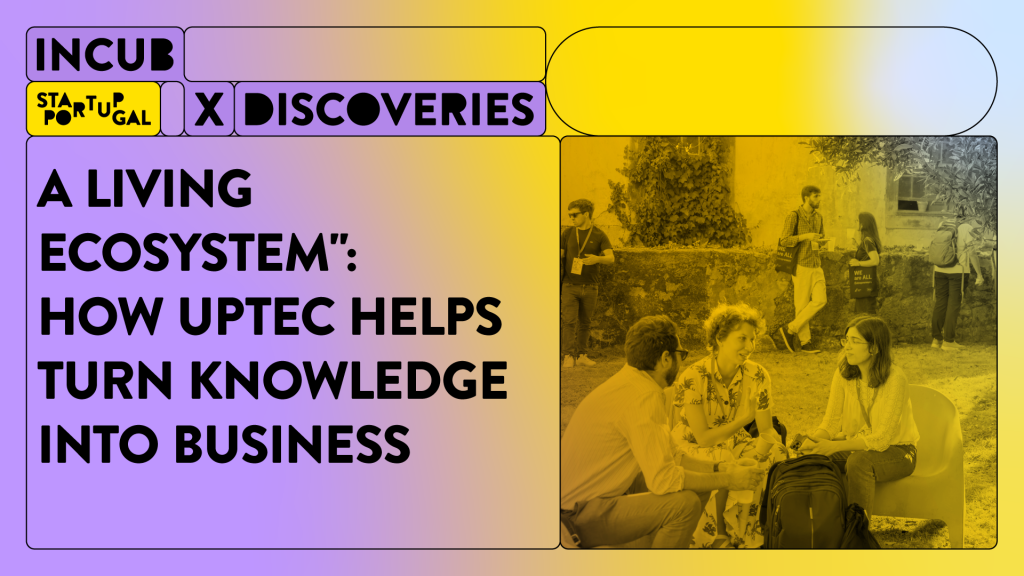
In this edition of #IncubXdiscoveries, we travel to Porto to discover UPTEC, the University of Porto’s Science and Technology Park and one of the country’s pioneering university incubators. We spoke with Joana Resende, President of UPTEC, about turning academic knowledge into companies, a living ecosystem where startups and industry grow side by side, and supporting founders from the earliest stages.
This content is available in Portuguese.
– How did UPTEC come about? What kind of projects do you incubate?
Committed to valuing the knowledge generated in its R&D centers, the University of Porto set out to encourage the creation of high-growth business projects from ideas developed within academia and in connection with the market. The clearest expression of that strategy was the creation of UPTEC, the U.Porto Science and Technology Park, a pioneer in higher education in Portugal, founded in 2007 as a meeting point between the University and the business world.
Since then, we have supported students, researchers, and entrepreneurs who want to turn a business idea into a company, as well as early-stage startups and the innovation centers of established companies.
– What does your incubation model look like?
Whatever the incubation format, virtual, cowork, or physical, UPTEC companies have access to a shared set of services. These include mentoring and business development provided by our in-house team, along with access to a network of global partners with experience in investment, internationalization, and industry.
Every year we run more than 150 events for the community, from themed workshops to capacity-building and networking sessions. The on-site formats also include access to cowork spaces, offices, or labs, as well as meeting rooms and event spaces shared by the whole community.
– Tell us the story of a startup that left its mark on the incubator. Where did incubation with you make the difference?
More than 860 business projects have passed through UPTEC, so there are many stories worth telling. Smartex, now a graduate company, is a clear reflection of our mission.
Founded by former students of U.Porto’s Faculty of Sciences and Economics, who attended the School of Startups for Entrepreneurs in the early days of the project, the team developed advanced automatic monitoring and artificial intelligence systems to reduce defects in textile production, helping brands and factories improve quality, cut waste, and increase sustainability.
Since then, Smartex became the first national winner of the Web Summit Pitch competition and has raised around 60 million euros in funding, while serving global clients and setting up a technology center in Turkey, establishing itself as one of the most promising Portuguese startups in smart textiles.
– Failure is also part of the journey. What is the biggest lesson from something that did not go well?
One of our biggest lessons was realizing that infrastructure and talent, on their own, are not enough. Not every project is ready to benefit from incubation at the same moment. That realization led to the creation of Foundations, a remote pre-incubation program that supports entrepreneurs at an early stage, helping them structure ideas, avoid common mistakes, and build more solid foundations for sustainable growth.

– What makes your incubator stand out? In other words, what do you have that helps startups succeed?
UPTEC’s main differentiator is that it works as a living ecosystem, where startups, innovation centers, and large companies coexist and interact continuously. This closeness means the knowledge generated at the University of Porto is quickly turned into business solutions, and the real challenges of industry shape new lines of research. That two-way dynamic is hard to replicate elsewhere.
Another distinctive element is our clear focus on supporting projects in their early stages. Through structured acceleration programs such as the School of Startups for Entrepreneurs, we work from the outset on critical topics like technological and market validation, defining the value proposition, and building sustainable business models. We also take part in national and international projects that give our companies real networks and opportunities, such as ScaleHER, which supports female entrepreneurship, and ST3ER, which has already distributed around 400 thousand euros in cascade funding for tourism projects.
On top of this comes a very close connection to industry and investment. We aim to ensure a continuous link with mentors and specialists through themed workshops, one-on-one support, and networking events that bring startups closer to industrial partners, clients, and investors. It is this combination of academic knowledge, practical market guidance, and access to relevant networks that consistently drives the success of the startups that pass through UPTEC.
– Community is one of the factors that distinguishes an incubator from an office center. How do you nurture yours, and what plans do you have to make it more cohesive and fertile?
We look after our community intentionally, creating moments and channels that encourage sharing, collaboration, and connection to industry. Throughout the year, we organize events focused on topics that matter for startup growth, along with networking sessions and initiatives that link them to the ecosystem, letting companies exchange experiences, spot shared opportunities, and form partnerships inside and outside the community.
We keep in close contact through direct channels and a weekly newsletter, and we actively promote incubated projects through initiatives like Out of Office and Open Doors, which reinforce a sense of belonging and a more human community. We also invest in events that build cohesion and collaboration, such as the Community Gathering or Cheers, a showcase and pitch session where new companies joining us get the chance to introduce themselves to the community.
– What are the main challenges for incubation in your specific context?
One of the main challenges is the need to grow and diversify our incubation spaces to keep up with rising demand. In 2025, we supported 251 projects and brought 64 new ones into the ecosystem, which shows UPTEC’s momentum and appeal.
Another significant challenge is the growth of deep tech projects, which involve longer maturation cycles and greater funding needs. In this context, it is also decisive for us to keep track of the new European growth-capital instruments, to make sure our startups not only get off the ground but can scale and stay competitive within Europe.
– Is there any news, event, or initiative you would like to share with us?
Yes! We have just launched Matching Founders, a new initiative that tackles one of the biggest challenges in entrepreneurship: finding the right people to build a solid founding team ready to develop a business. Aimed at early-stage entrepreneurs, Matching Founders connects founders with potential co-founders who have the ideas, talent, and ambition to create projects together.
ABOUT #INCUBXDISCOVERIES
#IncubXdiscoveries is Startup Portugal’s monthly feature that will help you discover Portuguese incubators. What projects they incubate, how they manage their community and what success stories they’ve had and future projects are some of the topics covered in these interviews.
If you’d like to find out more about UPTEC, either because you’d like to see your project incubated in this region or because you’d like to establish a partnership, contact the Startup Portugal team at incubadoras@startupportugal.com.
Other blog posts