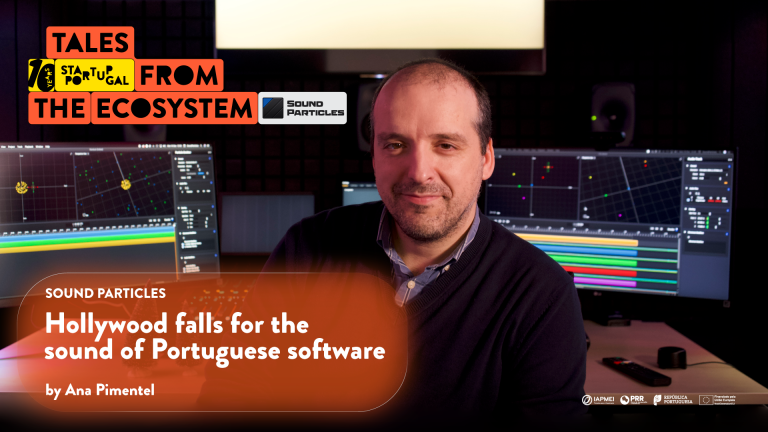
Sound Particles. Hollywood falls for the sound of Portuguese software
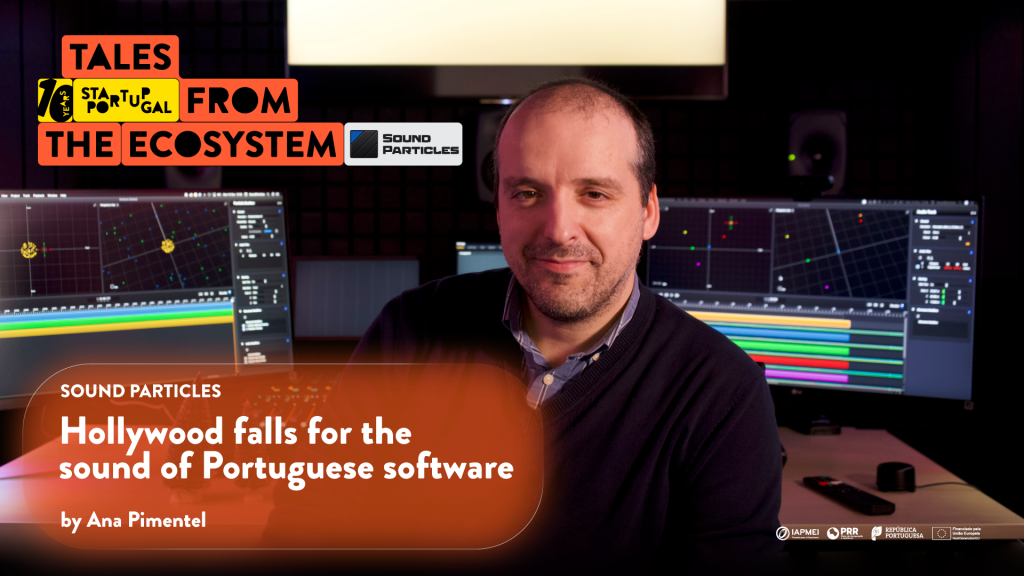
by Ana Pimentel
He built 3D sound software in his spare time, and one email was enough to land him a presentation at Skywalker Sound, in Los Angeles. From film to music and video games, the Leiria startup is behind many box office hits.
This content was originally written in Portuguese.
When Nuno Fonseca was 15, he went to hear an orchestra for the first time. The venue was fairly small, “with really good acoustics,” and he remembers the violins starting to play and realizing that no stereo recording could give him that kind of experience. He was captivated. “The Japanese have the word ‘kando’ to describe this kind of experience, one that almost lifts the soul,” the CEO of Sound Particles explains.
At the startup’s office in Leiria, he tells us he has always had three great passions: technology and computers, music and sound, and film. As a student, he managed to keep “a foot in both worlds”: he was enrolled in engineering at Instituto Superior Técnico, but he also attended classes in the composition degree program. When he crossed over to the other side and became a professor, he kept a hand in each: he taught Computer Engineering at the Polytechnic of Leiria and Music Technology at the Lisbon School of Music.
Between these two loves, there was still the seventh art. “I realized that the coolest visual effects I’d seen in movies used particle systems, a computer graphics technique that creates thousands of tiny points that, together, form things like dust, smoke, storms, fairy dust, and so on. I thought it would be interesting to do the same with sound, in other words, to create thousands of small sounds that, together, would produce absolutely fantastic soundscapes, just like visual effects do.”
The idea came to him about 16 years ago, but he only started working on it after finishing his PhD, in 2012. He did it in his spare time, almost as a hobby. The result, however, was professional. From 2012 to 2014, he built computer graphics software for sound. It was his “pet project,” he tells us. When the chance came up to travel to Los Angeles for a conference, he had an idea: email a few people in the industry to introduce himself and the technology he was working on. With two weeks’ notice, he didn’t really think it would work, but he had nothing to lose. He sent them.
The first reply couldn’t have been better. It came straight from Skywalker Sound, the studio founded by George Lucas (Star Wars). “It’s the biggest and most respected film post-production studio in the world. They invited me to Skywalker Ranch to give a presentation, which I did, and then, within six months, I ended up giving talks at Warner Brothers, Universal, Paramount, Sony, Fox and, later, Disney, Pixar, Apple, Google, Blizzard, Netflix, and many others,” he tells us.
When he flew to Los Angeles, Nuno had only a prototype, but it was enough to catch the attention of the film industry’s biggest names. They immediately asked when they could “start playing” with the software, and he asked for two months to “smooth out the rough edges.” In January 2015, he sent them the first version. The first film to use the Portuguese engineer’s software was the Poltergeist remake, in 2015. There wasn’t even a company yet, just talent and a lot of dedication from Nuno.
Two years later, there was no turning back. He “worked up the courage” and officially founded Sound Particles, even knowing he would lose a third of his teaching salary. Over the next two years, he kept the same workload at the university and earned less, but he was able to hire two juniors to work with him. In January 2017, they moved into Startup Leiria, but the volume of work called for more resources. It was time for another leap.
So, what is this startup all about?
One day, Nuno Fonseca was scrolling through Facebook when he saw a video of a French startup building something that could end up similar to what he was working on. He knew right away there was no time to lose. He had to hurry, and that meant looking for investors. He spoke with Blackmagic, a multimedia company, and the interest was such that they wanted to buy the startup. “They offered me a figure with a lot of zeros, and it was one of those moments when your knees start shaking,” he recalls. But the conversation ended there: Nuno turned it down. Shortly after, he closed a €400,000 investment with Indico Capital Partners and Red Angels.
With this investment, the team grew to 10 people, Nuno left higher education to work exclusively on Sound Particles, and the projects started adding up. By the summer of 2026, the Portuguese startup’s software had been used in the production of films such as Dune, Mission: Impossible, Oppenheimer, Star Wars, and Indiana Jones, and series such as Game of Thrones, Stranger Things, House of the Dragon, Star Trek: Discovery, and Wednesday, among others.
“The fact that we started at the top, in this case Hollywood, and on top of that with Skywalker Sound, which is number one, obviously opened a lot of doors.”
Nuno Fonseca, CEO, Sound Particles
And all because he sent an email without even knowing whether it would be read. “I’m very lucky to be able to bring my three great passions together professionally,” he says. And the software used by the film industry is just one of the ways he does it.
After film and television, the Portuguese startup turned to the video game industry and counts major companies such as PlayStation and Blizzard among its clients. “Fortnite, for example, uses our software, which obviously gives me enormous satisfaction, but it’s a particularly difficult market financially, because sound is very undervalued,” he says. That’s why they also moved into music, developing other creative tools, both for the engineers who mix albums and for the artists.
In the last two years, the Grammy for Best Immersive Audio Album went to two artists who “made heavy use” of Sound Particles products: Peter Gabriel and Justin Gray. French composer Jean-Michel Jarre is also an avowed fan of SkyDust 3D, a synthesizer created by the Portuguese startup that delivers immersive three-dimensional sound, the first of its kind in the world. Still in music, the Sound Particles office in Leiria also produced an app that helps place sound in space. “In practice, with the app, I simply point to where I want the sound to be,” he demonstrates, to the sound of a Japanese song.
Even so, the entrepreneur knew he would “hardly become a unicorn selling software or creative tools,” and started exploring what else he could add to the Sound Particles product portfolio. This is what he found: the entire entertainment industry is moving to 3D, because perceiving sound coming from every direction “is much more natural and immersive.” But there’s a problem: how can people replicate this experience at home?
“What people increasingly use is headphones, and although there are some 3D sound solutions for headphones, they leave a lot to be desired and don’t provide a true experience,” he tells us. The challenge is such that more than 100 PhDs have been done in the field, and no one has solved the problem yet. “Big Tech companies spend millions and millions in this area without reaching a solution that works. But we, in our naivety, think we’re the ones who’ll pull it off,” the CEO says. Sound Particles has been working on a solution of this kind since 2019.
From idea to reality: what does it take?
To build the technology that will perfectly recreate the 3D sound experience on headphones, they brought together several fields, such as computer vision, computational physics, and artificial intelligence. “We had to make advances in computational physics that go beyond the current state of the art,” he says. But the challenges are many. For headphones to “trick the brain” of the person wearing them, they need to know the shape of each person’s ears and head, for example, which makes the process considerably harder.
Although they haven’t reached the ultimate solution yet, Nuno says the product they have in hand shows the lowest error compared with the competition. And the competitors are heavyweights: companies such as Dolby, Apple, Meta, and Sony, among others. “We’ve been on this project since 2019, and it hasn’t brought Sound Particles a single euro in revenue, but we believe it has huge potential.”
Beyond creative tools and 3D sound for headphones, Nuno Fonseca also realized that Sound Particles could be used to create data for training neural networks. “If you want to use artificial intelligence in sound, for speech recognition, noise removal, or another application, it will need massive amounts [of data], and we can export audio at absolutely fantastic quality, with all the metadata,” he says. This allows them, for example, to enter the defense sector, where they are already active with a paid pilot project.
When we spoke, the Leiria startup had raised a total of €4 million in investment and was in negotiations with two investors to close another round or two. The focus was entirely on developing the headphone technology, which is “highly strategic” for the startup. The business model will then involve licensing the technology to streaming platforms such as Netflix or Spotify, to video game platforms, and to smartphone or headphone brands, for example. In the meantime, they will keep investing in software, creative tools, and AI datasets, which the entrepreneur believes will become the main source of revenue in the medium term.
“Working at a startup means making an omelet without eggs. Our competitors have top-quality eggs and budgets completely different from ours, but we insist on making the omelet without the eggs,” he says. He may not have the eggs, but no one can take away the experiences he has had at Sound Particles. Walking into and getting to know Hollywood studios, meeting people he admires, being at the same event as Steven Spielberg, or watching an episode of The Big Bang Theory being recorded are memories he will hardly forget. “For someone who loves film, this has been an absolutely fantastic journey,” he concludes.
ABOUT TALES FROM THE ECOSYSTEM
Every startup begins with a person and a problem they couldn’t ignore. In Tales From The Ecosystem, we ask Portuguese founders two questions: what is this startup, really? And what did it take to get from idea to reality? The answers take us from the first spark to the business model, the funding rounds and the markets still ahead, in their own words.

Other blog posts