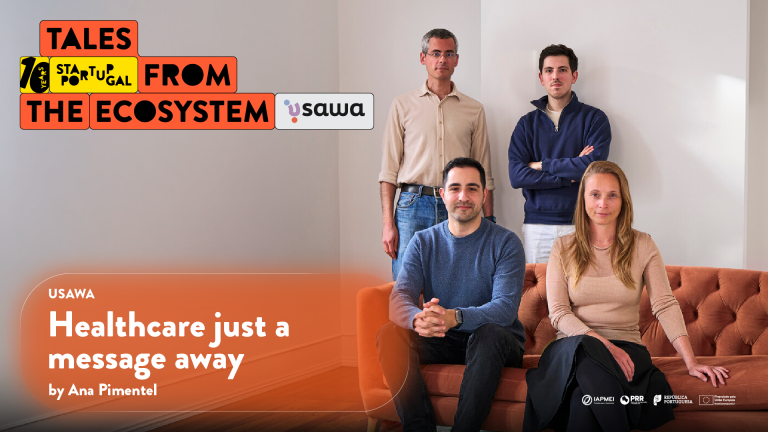
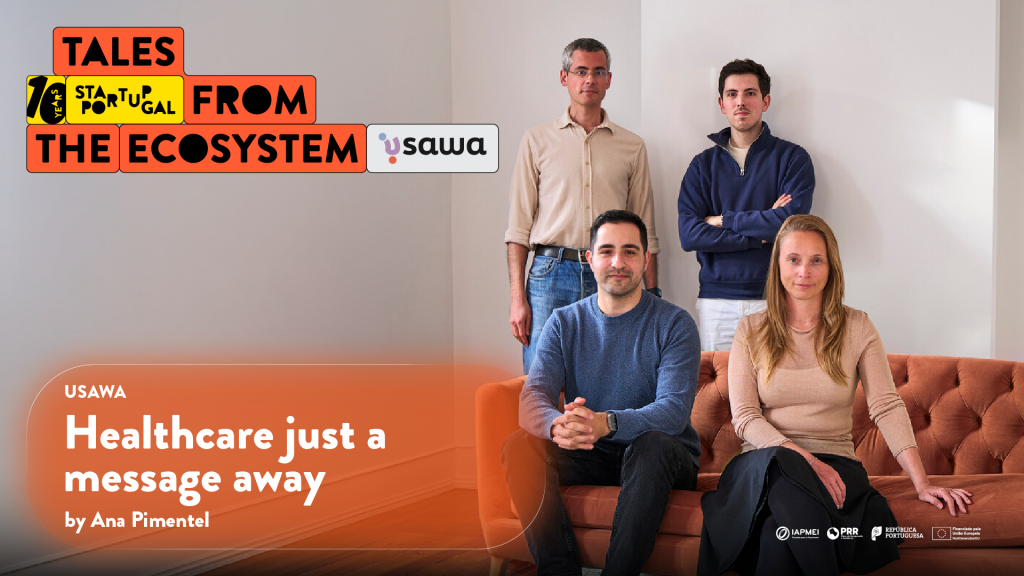
Usawa. Healthcare just a message away
by Ana Pimentel
All it takes is a WhatsApp message for Usawa’s artificial intelligence to connect a child with a pediatrician. The Portuguese platform’s ambition is to reach every person in the world, across every medical specialty.
This content was originally written in Portuguese.
It means “equality” in Swahili, but its mission needs no guide or interpreter. With Usawa, Luís Almeida Fernandes, an engineer by training, is dreaming big: he wants to bring the best healthcare to everyone in the world. Too utopian? Not for the Portuguese entrepreneur, especially since, to get there, he brings together doctors, clinical and hospital experience, and the innovation of artificial intelligence. As a starting point, he began by providing pediatric care to children through a chat. And all it takes is a WhatsApp message.
“Usawa stands for equal rights. And this has a lot to do with the years I spent in Kenya, because over there it’s a complete desert when it comes to specialized care. It’s a country of maybe 46 million people, half of whom are children, and it has fewer than 500 pediatricians. Portugal, with 1.7 million children, has 2,300 pediatricians,” the founder tells us.
One experience in particular stays with Luís and captures the problem: the young sister of a Kenyan housekeeper who died of what the family said was “gastritis,” with no medical confirmation of the diagnosis, because the girl never even made it to a hospital. Access to healthcare is so difficult in Kenya that people die at home of unknown causes, without ever knowing whether treatment could have prevented it, he explains.
The Portuguese entrepreneur couldn’t stay indifferent. With a career shaped by international experience, Luís Almeida Fernandes reached a point in his life where he wanted to do more for these people than for the large consulting firms he had worked for. After more than 15 years as a partner at McKinsey, in the New York and Nairobi offices, working on the digital health market, he returned to Portugal in 2022 to join the National Health Service (SNS). He led SNS 24 and the National Telehealth Center, because even then he wanted to serve people.
The experience lasted six months. His drive to change healthcare, and the speed and pace that define innovation, weren’t a perfect match for the procedures inherent to public service, which the founder stresses are necessary.
“I came to the conclusion that when it comes to innovative things, it makes more sense to build them outside and then integrate them. The public sector isn’t designed as an innovation machine, nor should it be. It should be a machine for selecting tools that are useful to people. And that’s when I realized I could probably bring more value to people from the outside than from the inside,” he explained. The desire is still there, though: the dream is for Usawa to one day be part of everyday life for everyone in Portugal.
So, what is this startup all about?
Usawa is a digital clinic where the interaction between doctor and patient happens over WhatsApp. Between the two sits an artificial intelligence system, trained specifically for this purpose, that asks the initial questions, collects the answers, and prepares a detailed report for the doctor, including possible diagnostic and treatment recommendations.
Once they receive the report, doctors have full discretion. They can ask the agent to put more questions to the patient and analyze that information again. They can disagree with the recommendations, reach a different diagnosis, or change the treatment, which also trains and improves the agent. Or they can agree and move forward with the suggestions. The decision always lies with the healthcare professional.
To get this approach off the ground, Luís Almeida Fernandes first focused on children and pediatricians. That was the solution he launched with. The second area he decided to tackle was the over-40 age group, with a focus on healthy aging. Step by step, the goal is to take the technology to every area of healthcare and every age group.
When we spoke, in the summer of 2026, Usawa had 23 pediatricians working on the platform and 11,000 registered children, averaging 1,000 to 1,500 consultations a month and covering the entire country. It was also running a pilot with insurer Médis to integrate the service into its offering and reach a market of 10,000 families. Which brings us to the business model. How much does all this cost, and how much money does it generate?
Usawa has a free tier (something Luís Almeida Fernandes won’t give up), available to anyone living in Portugal, with shorter hours and doctors available only for acute cases. Then there’s a paid version (a €10 monthly subscription at the time of our conversation) with extended hours, shorter wait times, access to specialist pediatricians, follow-up consultations, and in-depth support on sleep and nutrition. This is the consumer-facing segment.
But Usawa’s big bet lies elsewhere: in the corporate market, meaning insurers and hospitals. So it’s no surprise that the startup’s main target market is the US, which “has the best pediatric hospitals in the world,” the founder explains. At the time of our conversation, Usawa was already in talks with four of them: Boston Children’s Hospital, Children’s Hospital of Philadelphia, Lurie Children’s Hospital of Chicago, and Children’s Hospital Los Angeles.
On the other side of the Atlantic, the game plan is different. The business is pitched directly to hospitals and their affiliated clinics, and the technology is brought to pediatricians, including subspecialists. That way, during a general pediatrics consultation, the doctor can quickly ask a colleague in another specialty to follow up, and that colleague instantly receives a report with all the information on the patient. Everything happens digitally, with the help of AI, but if an in-person appointment is needed, they handle the referral themselves. “They’re very interested. These are leading institutions, and it’s a privilege to be talking with them,” the founder tells us.
The interest in the US is no accident: in 2025, healthcare accounted for around 18.5% of the country’s GDP. “It’s the largest market in the world, there’s nothing else like it. And before we reach a point where I’d say it makes sense to go to another country, like Germany or France, five or ten years will go by, because there’s a lot to do there,” he says. Portugal, the founder admits, is mainly an “impact” market, but the idea is to keep “growing, growing, growing.”
In Kenya, the country that first made the entrepreneur confront the problem of access to healthcare, a Usawa entity has already been set up, but at the time of our conversation it wasn’t yet operational; the CEO was still recruiting the Kenyan team. In Peru, where the startup won the 2025 Global eAwards (run by the international NTT Data Foundation), Luís was in contact with a foundation that works with Indigenous communities living in the country’s mountains, to give them access to the technology.
From idea to reality: what does it take?
For all of this to work, technological development can’t slow down, the founder tells us. To run a consultation on WhatsApp, the team had to redesign everything a clinical consultation involves, making the most of the technology available. How? By training AI agents. They gathered a large set of clinical guidance sheets, hundreds per condition, built on Portugal’s best clinical practices.
Based on these sheets, they trained the agent to only ask patients questions, so that it “never enters clinical risk,” Luís assures. This was key to developing the technology, he explains. “Because that was the main risk. If a recommendation were made directly to the parents, that would be a problem, because everything that happens has to be approved by the doctor,” he stresses.
Once the questions have been asked and the answers collected, another AI agent prepares the report with possible diagnoses and recommendations and delivers it to the doctor. From there, the decision is theirs alone. This agent tracks every decision, stores the information, and uses it to train itself and keep improving.
“You have to be extremely careful when doing AI in healthcare. What we wanted to guarantee in the overall design of the solution was that nothing clinically relevant would happen in the consultation without a doctor saying that’s exactly what should happen.”
Luís Almeida Fernandes, Founder, Usawa
The mission came to the founder’s mind first. Then came the idea of how to make it happen, and on top of that, the technology. But to really move forward, and to hire people, something else was needed: capital. On that front, Luís says he was “incredibly lucky.”
In a year and a half (the startup was founded in 2024), Usawa raised more than €200,000 in prize money: €120,000 for winning one of the categories of the Lisboa Innovation for All award, promoted by Lisbon City Council and Unicorn Factory Lisboa; $100,000 from the NTT Data international award; and $10,000 from the competition’s Portuguese edition.
“The second stroke of luck,” the founder says, was meeting two investors with “a very strong social mission”: Fundação AGEAS, which invested €150,000 in the company, and an angel investor who “is absolutely in love with what we do and what we bring to the world.” Laughing, he adds: “that’s me.” “I was already an angel investor before, and I still am,” he says.
When we spoke, Usawa was closing a new investment round, which Luís couldn’t say much about yet, but which would help the startup meet its goals. “Just for the record, it’s not for now, but I have a huge ambition to bring this into the SNS. In fact, I think where it fits best is as an access tool within SNS 24,” he concludes. Usawa means “equality,” remember? Accessible healthcare for everyone.
ABOUT TALES FROM THE ECOSYSTEM
Every startup begins with a person and a problem they couldn’t ignore. In Tales From The Ecosystem, we ask Portuguese founders two questions: what is this startup, really? And what did it take to get from idea to reality? The answers take us from the first spark to the business model, the funding rounds and the markets still ahead, in their own words.