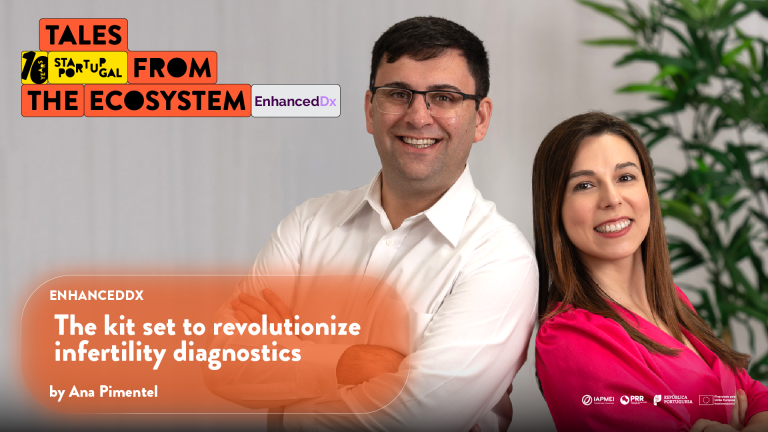
EnhancedDX. The platform set to revolutionize infertility diagnostics
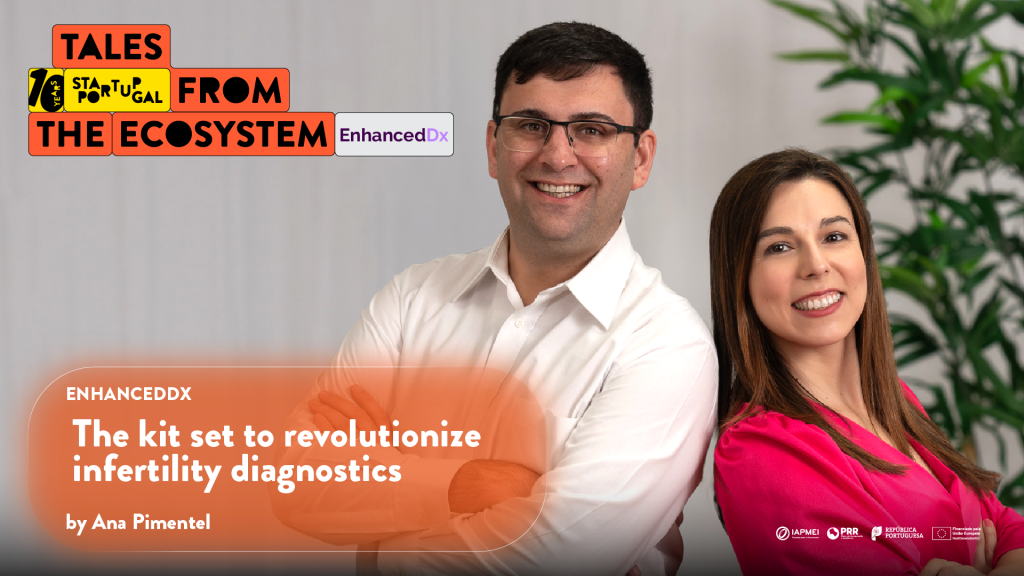
by Ana Pimentel
Andreia Trigo was born with a rare syndrome, which she wanted to “turn into something positive.” With her husband, she created a platform and a fertility testing kit to speed up diagnoses and help find treatments.
This content was originally written in Portuguese.
To explain what EnhancedDX is, we have to go back to Andreia Trigo’s teenage years, and to the moment a doctor told her she would not be able to have children. Her diagnosis of Mayer-Rokitansky-Küster-Hauser (MRKH) syndrome, which she received at 17, only came after many appointments and a lot of investigation into why the teenager still hadn’t had her period. Until then, doctors had no answers. It was only under general anesthesia, and with a camera, that they saw Andreia had no uterus. The first question she asked them was: “But does that mean I won’t be able to have children?” recalls the founder of EnhancedDX.
One in five thousand women are born with this condition. “It’s not even that rare,” she tells us. In the early 2000s, Google was still in its early days, but Andreia did all the research she could to learn about her diagnosis. Along the way, she met plastic surgeon Godinho de Matos at Hospital de Santa Maria, and for the first time felt that a doctor was truly listening to her. At 18, and in her first year of nursing school, she decided to have the surgery that would reconstruct her uterus, though it would not change her infertility diagnosis.
The procedure was long, and the post-operative recovery was longer still, but it worked. Physically, she was getting better, but emotionally the challenges were many. She cried and often asked herself why she was going through it all, but she received a piece of advice that shaped the rest of her life. “My father used to say that it wasn’t up to us to ask why, because one day we would understand. He repeated it so often, and it was so powerful, that I made a decision: if I can get through this, there’s nothing in life I can’t achieve. And it clicked that I was going to make it. I don’t know how, but I’m going to be happy, one way or another. And that decision shaped every step I took afterward,” she tells us.
From that moment on, something changed. She kept studying nursing, graduated, and emigrated to the United Kingdom, where she did a master’s at King’s College in London, and the urge to start a business began to take hold. Together with other colleagues, she founded an anesthesia training company for doctors and nurses, “which grew very fast” in the UK and Ireland. When we spoke, it had been around for 12 years and was still active. But something was still missing. “I didn’t feel fulfilled. I had the company, I was respected by my colleagues, but something was missing. I realized I had to create something in the field of human reproduction. Instead of forgetting my diagnosis, I had to turn it into something positive. There had to be a reason I was born this way.”
She went back to researching and concluded that a long time passes between when a woman starts trying to get pregnant and when she receives a possible infertility diagnosis. “Before a woman finds out she has polycystic ovaries, for example, an average of five years can go by,” she says. That delay bothered her. Around that time, she also met Frank Sullivan, whom she would go on to marry and launch EnhancedDX with. They were both doing research at the same hospital, and it was he, with a background in technology, who encouraged her to look for a solution that would help these families. They did it together, and in 2021 they founded the startup later named the most promising of Road 2 Web Summit 2025.
So, what is this startup all about?
The challenge Andreia wanted to solve was clear: how could she speed up infertility diagnoses and help those who wanted to have children? With this in mind, she and her husband got to work and created a digital platform where these families could enter their full medical history. Each answer entered on the platform was assigned a risk level, and at the end, the answers were assessed and patients referred to the next steps.
In the process, they realized some of the answers depended on information that could only be obtained through a blood test. So, in partnership with a lab, they created a test kit that could be used at home and would give the platform the data it needed. “Clinics started asking us for more and more tests, we grew our collaboration with labs and, in 2023, we also launched the company in Portugal, because Brexit meant we had to have a separate entity.” For Andreia, choosing Portugal was the obvious decision.
That same year, they moved on to the next phase of the product: patient pre-treatment. “Clinics used our platform, where patients completed their medical history, with informed consent, added their tests, and had their whole profile ready before treatment started. This was especially important for clinics in Europe that treat patients from other countries. Portugal, Spain, and Greece, for example, account for 50% of the clinics treating patients from the UK, France, and Germany,” she says.
To understand this part, we need some context on fertility legislation. Andreia tells us that in some countries, such as Germany, it isn’t possible to go ahead with fertility treatment using egg donation, for example. “A woman with low ovarian reserve can’t have fertility treatment there; she has to go abroad,” she explains.
With EnhancedDX’s platform, patients can request blood tests, semen analyses, serology, or other genetic tests in their home country, and the assessment is then done digitally by another clinic, in another country. It’s at the destination clinic that healthcare professionals access the report, which guides their clinical decision-making. In these cases, people can start their medication at home and only have to travel to the clinic when it’s time for egg retrieval or embryo transfer.
As technology advanced, a new opportunity emerged: agentic artificial intelligence. With this new capability, EnhancedDX can not only carry out and automate patient pre-treatment, but also support every other department within clinics, from reception to finance, speeding up the entire process. How? By getting all departments to communicate with each other and automating administrative processes, which frees up more time for professionals.
“It’s a much more intensive process, because we look in depth at all the systems clinics use to identify bottlenecks, and then we use these artificial intelligence systems to automate them,” she explains. By the summer of 2026, EnhancedDX had already started testing these AI agents in three clinics: one in the UK, one in Portugal, and one in Northern Cyprus. But all eyes were on the other side of the Atlantic, and on diagnostic automation.
After already working this way with more than 20 clinics in Europe, in 2025 the Portuguese startup entered the US market with its platform.
“The main focus for this arm of the company will be the US, because regulation in the field of artificial intelligence is more flexible than in Europe. Most of what we do, as long as it involves administrative processes, can be implemented in Europe, but automating diagnosis or writing clinical notes can’t, because they’re considered medical devices, and that requires registration with Infarmed and a process that can cost around €150,000 to €200,000,” she explains.
With this model, Enhanced’s software suggests a diagnosis for each patient to doctors, based on their medical history and test results. Beyond suggesting a diagnosis, it explains its reasoning, but the doctor always has to act on that suggestion: either confirm or reject the diagnosis, or ask for more information about it. It also suggests a personalized pre-treatment plan based on the data collected. When we spoke, the Portuguese startup was already an active member of the American Society for Reproductive Medicine and the European Society of Human Reproduction and Embryology.
From idea to reality: what does it take?
When we spoke, Andreia Trigo was talking to us from the UK, but she traveled to Portugal every week. In total, nine people worked at the startup, most of them at the company’s office in Linda-a-Velha (Oeiras), a decision that also stemmed from her husband Frank’s wish to live in Portugal. But her disappointment with Portuguese investors’ appetite, along with memories of the time she had to emigrate, have kept delaying Andreia’s own move to the country where she was born.
Despite winning the Road 2 Web Summit award in 2025, at the time of our conversation the Portuguese-British startup had still not raised investment from Portuguese funds. Closing a €2 million seed round, they had secured €1 million from US fund Eagle Venture Fund, and it was also in the US that they were focusing their efforts to close the remaining million. Before this round, the startup had raised €300,000 from UK business angels.
Looking ahead, the goal is to keep growing and reach sustainability. “We want to be more established in the US. We want to move forward with this agentic AI side and go from three clinics to twenty. That will allow us to break even, which I think matters more for companies today than it used to. Companies used to be able to go many years without making a profit,” she says.
As for their work with European clinics, there are numbers that show results. When we spoke, EnhancedDX knew it had contributed to the birth of at least 39 babies. They lose track of many patients, but stay in touch with others for longer, because during the process they see a psychologist who is part of the startup’s team.
“There are some very challenging stories, because these are people who have spent many years unable to get pregnant. At our company, people can have psychology sessions for a symbolic fee at any point in the process, because receiving a diagnosis of diminished ovarian reserve isn’t the same as getting test results from your doctor saying your cholesterol is high,” she says. Now, every time an EnhancedDX baby is born, they ring a bell at the Linda-a-Velha office.
Going forward, the nurse and entrepreneur would like EnhancedDX’s product to be adopted by more clinics, to increase their efficiency and, with that efficiency, help more people access the treatment they need. “We know that only 2% of people who need treatment can access it. So, if clinics have more room to treat people without having to increase staff, costs may come down and treatment may become more accessible,” she concludes.
ABOUT TALES FROM THE ECOSYSTEM
Every startup begins with a person and a problem they couldn’t ignore. In Tales From The Ecosystem, we ask Portuguese founders two questions: what is this startup, really? And what did it take to get from idea to reality? The answers take us from the first spark to the business model, the funding rounds and the markets still ahead, in their own words.

Other blog posts