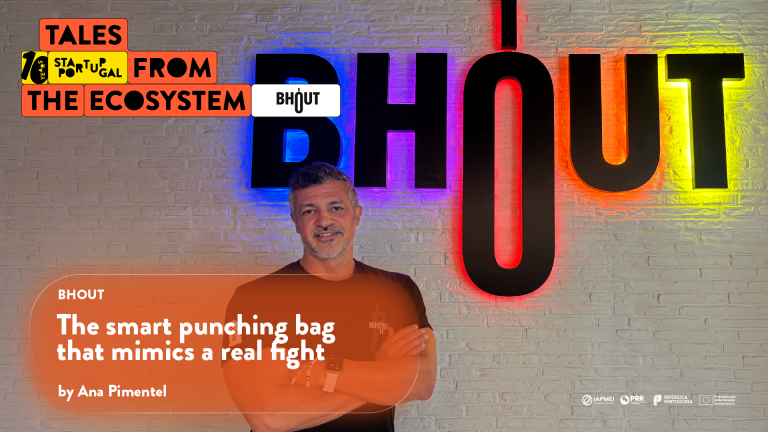
BHOUT. The smart punching bag that mimics a real fight
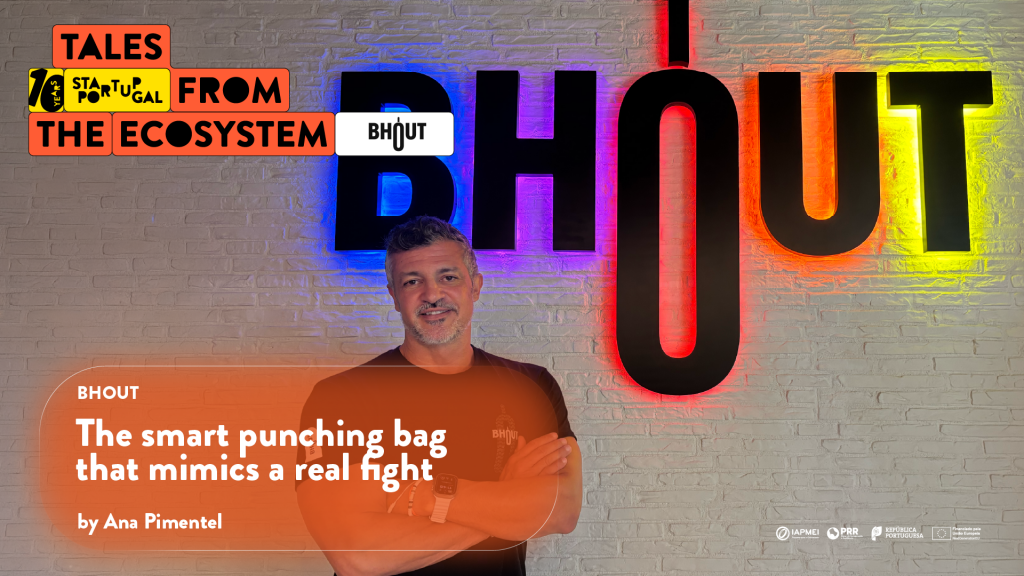
by Ana Pimentel
Mauro Frota dreamed of a punching bag powered by artificial intelligence and didn’t rest until he had built it. First in his home garage, then in his own factory, and for the future, he wants the world.
This content was originally written in Portuguese.
It sounds like a metaphor, but it’s literal: the idea for BHOUT came from a dream Mauro Frota had in 2014. A dream the entrepreneur tried hard to ignore, to let slip away, but that ended up sending him on a relentless search. When he looked online, he realized nothing like what he had imagined existed yet. Would it be possible, then, to create a smart punching bag just as it had appeared in his dream? In August 2021, what had seemed like an abstract idea became reality.
“I dreamed I was hitting a bag. And at first, that bag gave me metrics, which is what we have today at BHOUT. But at a certain point, the bag turned into a person, a target, which is what we’re developing for version 3: a bag connected to augmented reality glasses,” he tells us at the club he opened in Miraflores (Oeiras), one of seven locations the brand had in operation in the summer of 2026.
The mind behind the world’s first smart punching bag is Portuguese, entrepreneurial, and lives in the body of a born athlete. Mauro has 35 years of involvement in martial arts such as karate, kickboxing, Muay Thai, and jiu-jitsu, among others. In 2005, he opened his first business, the Evolution fitness centers, which he left six years later. “I’m very proud to have been part of that project. And somehow, in my head, I always wanted to connect these two worlds. Because martial arts are perhaps the most functional stimulus there is for human longevity,” he says.
Once he gave in to the dream, he had to spend a lot of time learning. As a “non-tech founder,” he first focused on what the body of a bag like this would look like, then tried to understand how venture capital worked, all without leaving home. For six years, BHOUT, which Time magazine would name one of the 200 best inventions of the year in 2023, was built in the garage.
For the first two years, he worked on the idea alone. “I spent all my pocket money, all my savings,” he says. Then Pedro Barata, an architect by training, joined him, and together they began designing the first parts and working on the first iterations of the product. In six years, they built the body of the bag.
When they left the garage, they moved to Clube 7, in Lisbon, where they spent two years running sensory nudging studies, that is, figuring out how they could use music and light to boost the motivation of people training. But then the Covid-19 pandemic hit, they left Clube 7, and moved into a space of their own on Avenida de Roma.
“My co-founder and I pooled all our savings, I took out a second mortgage on my house, but we only had money for either the construction materials or the labor. Not both. Obviously, the materials were the priority,” he says. Then, with their own hands and the help of friends and partners, they built everything.
When we spoke, BHOUT clubs had more than 3,000 registered users, an average of 500 per club. The Avenida de Roma club is already considered a “mature club.” “A club takes two years to reach maturity and then tends to stabilize. This club where we are [Miraflores] is already close to 500 active clients. So everything suggests it will hit the same metrics as the others. They break even very quickly, either on opening day or the following month,” he adds.
The model worked, and in the summer of 2026, Mauro was already closing Master Franchise agreements for the clubs in Brazil, Chile, Spain, France, and Germany, which allows them to scale while lowering costs.
So, what is this startup all about?
The club, where everything happens digitally and which employs no one beyond one trainer per session, was the first piece of BHOUT’s business puzzle to fall into place, but the plans go further. Mauro wants to build an entire ecosystem around his product. But first, what is this product?
It’s a multilayer bag, with each layer mimicking a different density of human tissue. “It mimics a person from a biological point of view,” the CEO explains. It has more than 300 moving parts, designed to be struck, and combines sensors with computer vision, which allows it to analyze a strike in 300 milliseconds. It also uses artificial intelligence: it’s the world’s first smart punching bag.
With sensors at the base and computer vision at the top, the BHOUT bag can tell which area the user is hitting, measure the accuracy of each strike, and adapt to whoever is using it: it knows their height, whether they’re right- or left-handed, their level of fatigue, and the strength and speed with which they train. “And now, with version 3, it’s finally starting to measure the biomechanical technique of each strike,” Mauro reveals. It also already has hardware that allows it to connect to augmented reality glasses.
With this kind of technology, the BHOUT bag can mimic what is, in practice, a real fight, without anyone getting hurt or the bag hitting back. As the workout goes on, strikes are turned into points and the session works like a game, with people seeing their points in real time. At the end of the session, each user can see their place in the rankings in the app. In 2025, the startup launched the BHOUT Games, which Mauro called “a success” and which already has the entrepreneur daydreaming about competitions between national teams.
All of these features are processed in the bag itself, which is also why the product is so complex. “That’s why we can process a strike in 300 milliseconds. Obviously, we’re not going to give feedback in 300 milliseconds, because that would be too much feedback for us to process. But we’ll analyze a cluster of techniques and give feedback on those techniques, the way a human trainer would,” he explains.
With the latest version, the hardware is ready for several new developments. One of the entrepreneur’s ambitions is for the bag to learn to coach, like a human. “We created something called the BHOUT Behavioral Change Matrix, which brings together the four most important lines of research in psychology and behavioral change. That’s how our human coaches are trained, and that’s how our AI coach is being trained,” he says.
The goal is for this non-human trainer to be able to analyze biomechanical movements and give feedback, and to teach strikes not only from boxing but also from other martial arts, since the bag can measure not only punches but also elbows, knees, and kicks. All so that it’s possible to rent a bag outside session hours and let anyone learn the technique.
And it’s all digital. Through the club’s app, people buy a session, book a spot, open the club door, open and close their locker, and connect to the bag. A mature club averages 12 sessions a day, with one coach per session, and is open from 7 a.m. to 10 p.m. Besides clients and trainers, there’s a cleaning team twice a day.
At the center of it all is the bag, the core of the BHOUT ecosystem, but the long-term vision is for the same hardware to serve multiple markets. “The technology doesn’t end here,” he says. The next phase involves developing the software, improving the AI algorithms, and creating new offerings with these resources.
From idea to reality: what does it take?
The Portuguese startup’s first outside investment came in 2022, directly from business angels. The following year, they secured more funding, this time with some venture capital investors on board. Then they raised a €10 million seed round from venture capital alone, the largest in Portugal at the time. Portuguese funds Lince Capital and Explorer Investments took part in the round.
Besides developing the product, they also had to manufacture it. “After we made a bag, we realized we couldn’t industrialize the process with an outside company, because there were no machines to manufacture this particular product,” the CEO says. So they partnered with another company, which helped them develop the machinery, and set up their own factory in Leiria.
In the summer of 2026, things were changing. As a hardware startup, BHOUT needed a lot of capital to build the factory, bring the punching bag to life and develop it, produce it, and open the clubs. “All of this has much higher setup costs than a software startup,” he says. Since one club alone doesn’t prove a thesis, they invested in five more.
Alongside the clubs, the Portuguese startup is betting on another vertical, B2B: it wants to sell to large companies, big gym chains, and hotel groups. One of the first companies to reach out was LinkedIn, which wanted to put bags in its Dubai offices. Marriott hotels did the same. And one day, Mauro got a call from boxer Jake Paul’s manager, and that’s how BHOUT became a Netflix partner for the fight between Mike Tyson and Jake Paul.
Their ambition is big and centers on the US market, which they haven’t entered yet because it’s “too important” to risk failing. “It’s the largest market in the world, with 200, 300 million consumers and a fitness penetration that broke records in 2026, passing the 20% mark of Americans who consume fitness,” he adds. To move forward with all these goals, they had to restructure the business and terminate contracts with some employees whose roles were no longer needed, since hardware development had been completed.
“We’re literally looking for the company’s sustainability, so we don’t depend so much on outside investors,” he says. He doesn’t rule out venture capital, but they want to approach it differently, because they’re no longer in the phase of selling the dream. “The dream has been sold, the company and the product are a reality. Now investors are asking us for a different company, with metrics. We’re at this turning point, and our focus has shifted much more to software and sales,” he concludes. Who knows, one day it might be possible to have a smart punching bag at home and learn strikes from Mike Tyson’s avatar.
ABOUT TALES FROM THE ECOSYSTEM
Every startup begins with a person and a problem they couldn’t ignore. In Tales From The Ecosystem, we ask Portuguese founders two questions: what is this startup, really? And what did it take to get from idea to reality? The answers take us from the first spark to the business model, the funding rounds and the markets still ahead, in their own words.

Other blog posts