“A (de)accelerator”: growing differently at Moagem de Sabóia
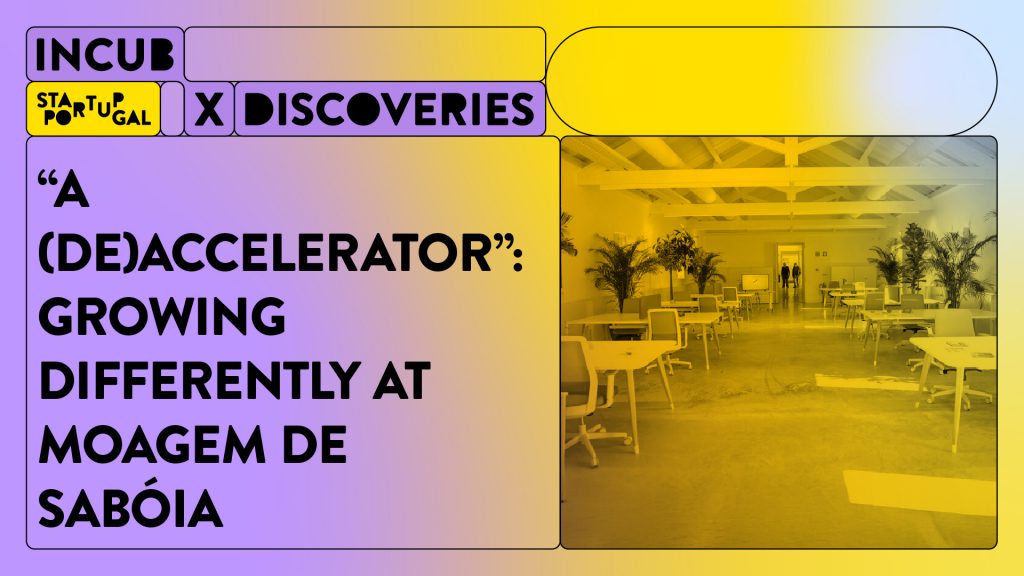
In this edition of #IncubXdiscoveries, we travel to Odemira to discover Moagem de Sabóia Business Incubator, a space born from the rehabilitation of an old industrial building and designed to turn heritage into innovation. We spoke with Ricardo Cardoso, Vice-President of the Municipality of Odemira, about building an entrepreneurial ecosystem in a low-density territory, the value of proximity, and what it means to grow differently.
This content is available in Portuguese.
– How did Moagem de Sabóia Business Incubator come about? What kind of projects do you incubate?
Moagem de Sabóia Business Incubator was born from the rehabilitation of an old industrial building, transforming heritage into a space for innovation. Its strategic location, next to the Southern railway line, reinforces the clear goal of creating a hub for economic dynamization, capable of attracting talent to the lowest-density area of the municipality of Odemira.
We support business projects in the idea, startup, or early growth stage, with a connection to the territory and a commitment to creating sustainable value.
– Do you have an area of specialization?
We are not a verticalized incubator, because we want to support all projects that add value to the territory, but we know that we want to create an ecosystem that favors the attraction of companies linked to the main sector of this sub-region, the agroforestry sector, whether through the valorization of forest resources or through the transformation of endogenous products.
– What does your incubation model look like?
Our model is based on three pillars: an attractive and functional physical space, with modern infrastructure in a building with identity; close technical support, with personalized mentoring adjusted to the needs of each project; and connection to the ecosystem, with links to institutional, business, and funding networks.
We offer physical and virtual incubation, support in structuring the business model, and capacity-building in critical areas such as management, funding, and marketing.
As a differentiating factor, we have the territorial environment marked by the quality of life typical of a low-density territory, with support services and connected to the country through Alfa Pendular and Intercidades train services.
– Failure is also part of the journey. What is the biggest lesson from something that did not go well?
We learned that building an incubator in a very low-density territory requires time, consistency, and continuous adjustment.
At an initial stage, it was essential to calibrate expectations, reinforce internal processes, and invest in team capacity-building. We had to take one step back to consolidate the foundations and, in doing so, be able to take two steps forward.
Another important learning was realizing that our communication was excessively institutional and not close enough to the target audience. We are now changing that approach.
– What makes your incubator stand out? In other words, what do you have that helps startups succeed?
Moagem de Sabóia offers something unique: an entrepreneurial ecosystem with time to think, create, and grow.
We often say that we are a (de)accelerator, because here there is work, there is ambition, and there is community, but not the constant pressure of urban centers.
In a context where Alentejo promotes “Vagar”, we show that it is possible to grow with consistency, grounded in quality of life and lower costs.
Despite the perception of distance, we are strategically connected to the country, less than two hours by train from Lisbon and just over one hour from Faro airport. We will soon conclude the agreement with CP to provide free travel vouchers for incubated companies, facilitating the mobility of teams, clients, and partners.
– What kind of projects or startups are you looking for right now?
We are looking for projects that want to grow with us and add value to the territory. We particularly value initiatives linked to the agroforestry sector, the transformation of forest resources, and the valorization of endogenous products, but we are open to any innovative project with potential for local impact.
– Community is one of the factors that distinguishes an incubator from an office center. How do you nurture yours, and what plans do you have to make it more cohesive and fertile?
We believe that an incubator is, above all, a community.
We promote a dynamic agenda with moments of connection between incubated companies, workshops, capacity-building sessions, and initiatives open to local companies. We have been strengthening strategic partnerships, with actions promoted by ANJE and a partnership with Navigator, strengthening our business ecosystem.
– What are the main challenges for incubation in your specific context?
The biggest challenge is proving that innovation is not exclusive to large urban centers. We chose to start in one of the areas with the lowest population density in the municipality. It could have been easier to start in another location, for example Odemira or Vila Nova de Milfontes, but it would have been less transformative.
We strongly believe that we will be able to affirm the concept of a (de)accelerator, because the counterpart is attractive: more quality of life with much lower costs.
– Is there any news, event, or initiative you would like to share with us?
We are in the final stage of negotiating an agreement with CP that will allow us to provide a limited number of free monthly travel vouchers to incubated companies, to be used by teams, clients, or partners.
At the same time, an ambitious project is underway: the creation of the Odemira Incubator Network. In addition to Moagem de Sabóia Incubator, already in operation, we have the Odemira Incubator under construction, the São Teotónio Technological Incubator in the public works tender stage, and the Vila Nova de Milfontes Incubator in the project contracting stage.
In a municipality that is the largest in the country, with a territorial dimension equivalent to some Portuguese districts, this network will make it possible to create a true entrepreneurial infrastructure with multiple hubs across the territory.
ABOUT #INCUBXDISCOVERIES
#IncubXdiscoveries is Startup Portugal’s monthly feature that will help you discover Portuguese incubators. What projects they incubate, how they manage their community and what success stories they’ve had and future projects are some of the topics covered in these interviews.
If you’d like to find out more about Moagem de Sabóia Business Incubator, either because you’d like to see your project incubated in this region or because you’d like to establish a partnership, contact the Startup Portugal team at incubadoras@startupportugal.com.
Other blog posts