“Innovation and social impact”: the mission behind IRIS
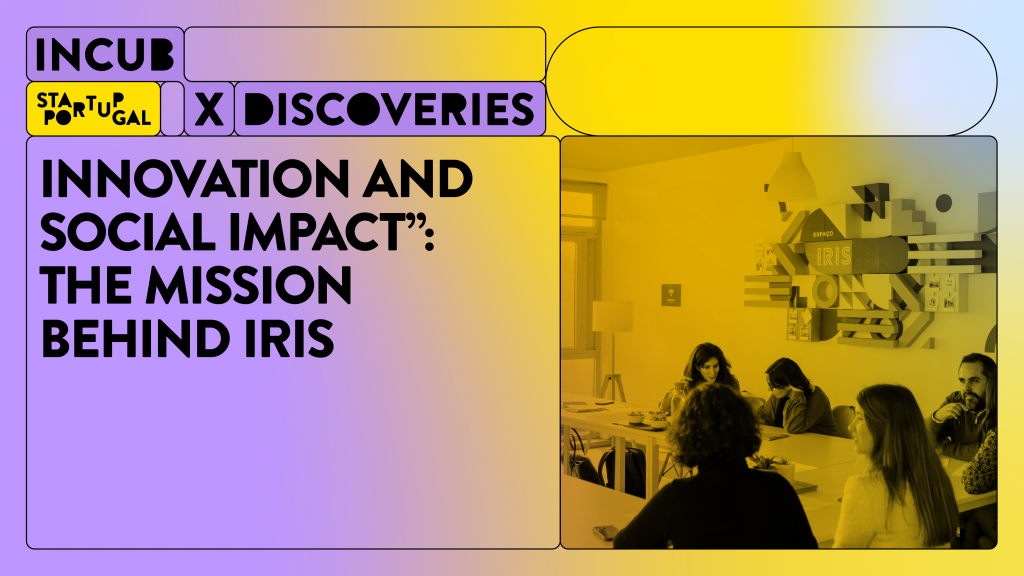
In this edition of #IncubXdiscoveries, we spotlight IRIS – Incubadora Regional de Inovação Social and its work supporting social entrepreneurship and impact initiatives. We spoke with Liliana Ribeiro, CEO of IRIS, about their incubation model, how they nurture an impact community, and the challenges of building sustainable social innovation projects.
This content is available in Portuguese.
– How did IRIS come about? What kind of projects do you incubate?
IRIS – the Regional Social Innovation Incubator was created in 2017 in the Tâmega e Sousa region, as part of an impact partnership co-funded by Portugal Inovação Social, promoted by Portus Park with social investment from the European Investment Bank Institute (EIB Institute). In 2020, to ensure continuity of the work developed, the non-profit association IRISOCIAL Incubadora de Inovação Social was created. IRIS supports the creation and development of social innovation projects, which are new ideas designed to solve serious social and environmental problems.
– Do you have any area of specialization?
Yes, innovation and social impact. IRIS has helped create an impact ecosystem by focusing its work on supporting social entrepreneurship initiatives and building capacity for social innovation among people and organizations.
– What does your incubation model look like?
As a social innovation incubator, IRIS’s incubation model is based on direct support to entrepreneurs and projects with social or environmental impact. Our incubation program, reviewed annually according to the main needs of our project network, includes services such as consulting (in areas like accounting, legal support, and communication), access to a network of specialists and mentors, incubation space and coworking, networking moments (e.g., contact with potential social investors), and access to specialized capacity-building actions. Some of these activities take place in person, but most happen online, with the possibility of being incubated in that format.
In addition to incubation, IRIS also runs acceleration programs. In response to challenges from national and international partners, we deliver specialized programs. One example is TUI Futureshapers Portugal, promoted by the TUI Care Foundation. Now in its 2nd edition in Portugal, it is delivered by IRIS and consists of an acceleration program for impact initiatives focused on tourism.
– Tell us the story of a startup that left its mark on the incubator. And where did incubation make a difference?
Fortunately, many social impact projects have left a mark on IRIS. Some of them we have supported since the beginning and are now institutionalized responses in the social impact field. One example is Pedalar Sem Idade Porto, a project incubated at IRIS since 2021. In 2022, the project had only its Founder, Sílvia Freitas, who incubated the project in person at IRIS and used our coworking space to work and meet with partners. In 2023, the project grew, investing in human resources and moving from IRIS’s coworking space to a larger space that could accommodate the team. Today, in 2026, and in another space, the team has 4 internal members, many recognitions, and a presence in several municipalities in the northern region. Incubation at IRIS, together with the effort of its Founder, allowed the project to scale at its own pace with the support of a specialized team.

– Failure is also part of the journey. What is the biggest lesson from something that didn’t go well?
Over its 9 years of growth, IRIS has gathered several learnings. The one that has had the greatest impact on incubator management relates to managing expectations around the participation of incubated projects in community activities. We know these entrepreneurs are focused on taking their missions and projects further, so the time available to participate in networking or capacity-building activities is not always what we expect. Over time, IRIS developed strategies so that community-building would happen at the pace of the projects in our network. This way, we can support initiatives without feeling that we are taking up too much time in their already very limited agendas.
– What makes your incubator stand out? In other words, what do you have that is unique and supports the success of the startups you incubate?
What drives the success of the impact projects we incubate is people. In addition to the IRIS team, which currently has 6 internal members, we have a Network of Specialists, Mentors, and Trainers made up of around 20 people, with expertise in different areas such as innovation, communication, business model, legal, circular economy, finance, impact measurement, among others. We also have a partner network of 17 entities, which enables IRIS to grow and improve its support for impact projects. This network of people forms a community that promotes social innovation and supports the projects incubated at IRIS.
– Community is one of the factors that distinguishes an incubator from an office center. How do you take care of yours, and what plans do you have to make it more cohesive and fertile?
IRIS takes care of its community through several initiatives designed to strengthen relationships within our network and increase proximity to the incubator. Some examples include our social and networking moments (e.g., Christmas, local festivities), which encourage the exchange of experiences and strengthen the social innovation ecosystem; capacity-building and support programs such as workshops, trainings, and mentoring, which support project development and promote closer contact between entrepreneurs; access to a network of specialists, mentors, and potential investors, which offers technical input and guidance, enriching the growth and sustainability of initiatives and increasing the connections of incubated projects; and daily communication of opportunities and challenges through an exclusive WhatsApp group for projects and our social media.
– What are the main challenges for incubation in your specific context?
In IRIS’s context, based in the north in Porto, and considering our vertical, social innovation, the main challenge is sustainability. Many social innovation projects struggle to establish sustainable business models, and even to reach a profit margin. Many others manage to define sustainable business models but struggle to enter a competitive market. This means IRIS also faces these challenges and has to adapt its incubation offer to this reality, marked by scarce financial resources among projects and initiatives operating in the social sector.
– Is there any news you’d like to share with us? Any event or initiative we should all add to our agendas?
At the moment, IRIS is preparing the first edition of a capacity-building initiative inspired by the community’s needs: the Management Course for Social Entrepreneurship. This is an advanced course covering essential topics across different areas of management, providing participants with practical and strategic tools to develop, manage, and scale social innovation projects. It will be especially aimed at entrepreneurs who already have projects underway, and it will be launched in 2026.
ABOUT #INCUBXDISCOVERIES
#IncubXdiscoveries is Startup Portugal’s monthly feature that will help you discover Portuguese incubators. What projects they incubate, how they manage their community and what success stories they’ve had and future projects are some of the topics covered in these interviews.
If you’d like to find out more about IRIS, either because you’d like to see your project incubated in this region or because you’d like to establish a partnership, contact the Startup Portugal team at incubadoras@startupportugal.com.
Other blog posts