“Our biggest milestone is consistency”: straight from In.Cubo
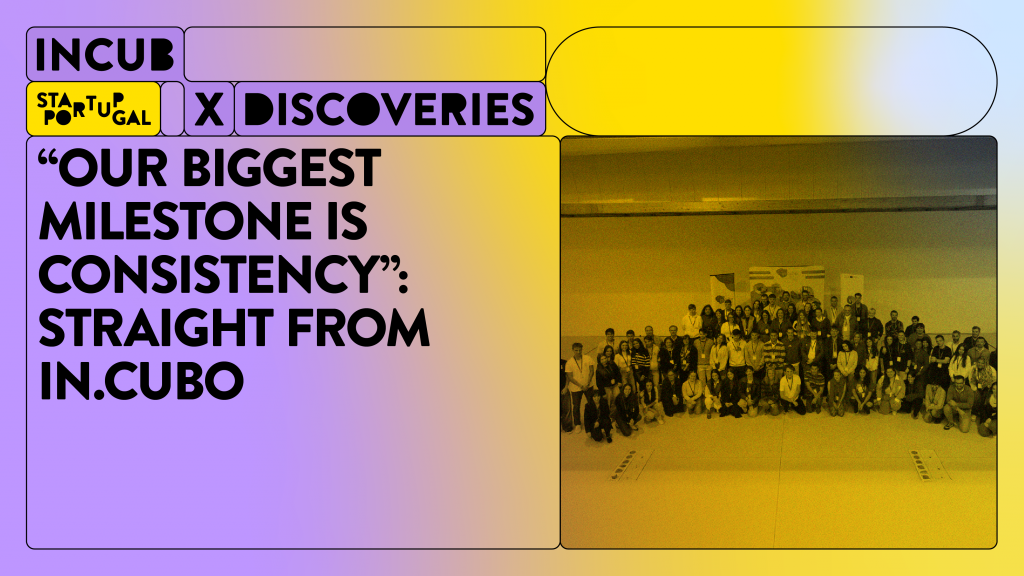
In this month’s #IncubXdiscoveries edition, we’re heading to Alto Minho to discover In.Cubo, an incubator focused on low-density territories with an approach that brings together innovation, industry, endogenous resources, and community. We spoke with Jorge Miranda, Senior Project Coordinator, about the incubation model, the strategic pillars, and the challenges of creating consistent impact.
How did In.Cubo come about? What kind of projects do you incubate?
ACIBTM – Associação para o Centro de Incubação de Base Tecnológica do Minho (In.Cubo) was established on March 1, 2007 as a private, non-profit association. It was born from the initiative of institutional founders, namely the Municipality of Arcos de Valdevez and the Polytechnic Institute of Viana do Castelo (IPVC), with a clear mission to enhance local resources and develop the regional economic base.
We incubate innovative business initiatives, focused not only on technology-based ventures but also on the valorization of the region’s endogenous resources. We support the entire project life cycle, from the ideation stage and Business Plan development to mature companies that require industrial spaces. Our scope is broad, ranging from technology and R&D to services and industry.
Do you have an area of specialization?
Our specialization reflects our location and our mission to work in low-density territories, turning challenges into opportunities. We have specific competencies and active projects across four main pillars: Rural and Agri-food Entrepreneurship, focused on valorizing endogenous products and innovation in mountain territories; Blue Economy, focused on collaborative and sustainable innovation in the Atlantic space; Social and Digital Economy, boosting social entrepreneurship and digital cooperatives; and Industry 4.0 and Digital Transition, supporting digitalization (AI, Cybersecurity) in traditional sectors such as footwear, furniture, and tourism.
What does your incubation model look like?
Our model unfolds across three sequential phases:
- Pre-Incubation (6 months to 1 year): Idea validation, guidance in developing Business Plans, support in setting up the company, and advisory services on funding systems.
- Incubation: Lasting 3 years (exceptionally extendable by 2 more). It can take place in a physical format (Office, Coworking, or Industrial Unit) or virtually.
- Continuous Support: Management advisory services, marketing, support for internationalization, access to credit, and links to the scientific community (IPVC and CiTiN) for R&D activities.
Tell us the story of a startup that left its mark on the incubator. And where did incubation make a difference?
More than a single story, our biggest milestone is the consistency and scale of the impact generated in the regional ecosystem. Our track record includes over 1,000 interviews, the selection of 888 entrepreneurs, and the completion of 173 business plans. This support translated into the creation of 378 supported companies (91 in physical incubation and 140 not incubated). Beyond direct support, we energized the community with around 300 events and more than 62,500 participants, creating a fertile environment for networking.
Incubation with us makes a difference especially for industrial or technological projects that require fast prototyping. Access to our 10 Industrial Units and to Fab.Lab Alto Minho (a digital fabrication lab) makes it possible to materialize ideas: moving from a computer drawing to a 3D object in just a few hours is a competitive advantage that is hard to find in conventional service-based incubators.
Failure is also part of the journey. What is the biggest lesson from something that didn’t go well?
Experience in a low-density territory has taught us that it’s not enough to create companies; it is crucial to ensure their sustainability, regeneration, and adaptation. We learned that startups stagnate if there is no close follow-up and a focus on digital and technologically advanced business models.
That lesson led us to implement projects such as “EMER”, “H2E” and “Digi4Future”, focused on personalized capacity-building and mentoring to increase survival rates. We also adopted the “triple helix” strategy (Science, Incubator, Startup) to combat entrepreneurs’ isolation.
What makes your incubator stand out? What do you offer that helps startups succeed?
Our distinctive factor is the symbiosis between cutting-edge industrial infrastructure and exceptional quality of life. We are located in a UNESCO World Biosphere Reserve, next to Portugal’s only National Park (Peneda-Gerês), with access to the Ecovia do Vez and outstanding gastronomy. We stand out by offering unique physical resources, with 10 Industrial Units for productive operations, as well as individual offices and coworking spaces.
We also stand out through technology: a Fab.Lab integrated into a global network for prototyping and a CITIN (technology interface center) connecting companies to applied research. And through a proximity ecosystem, with close articulation with CIM Alto Minho, IPVC, and Municipalities, facilitating access to decision-makers and cooperation networks.
Community is a key factor. How do you nurture yours, and what plans do you have to make it even stronger?
We nurture our community through a constant agenda of networking, workshops, idea competitions, and strong links with local and vocational schools to promote youth entrepreneurship. We also work with IPVC in ideation labs.
For 2026, we will reinforce this dynamic with sessions to share “Best Practices and Success Stories”. We will bring in guest business leaders to share first-hand experiences, interacting directly with our incubated teams and inspiring new entrepreneurs.
What are the main challenges for incubation in your context?
Our central challenges are low population density, which makes it difficult to reach critical mass (in quantity and quality) to keep the ecosystem continuously active; space management, managing infrastructure occupancy (currently with a waiting list) and ensuring the necessary rotation to welcome new ideas and move consolidated companies to Business Parks; and economic resilience, meaning being able to prepare companies for globalization and uncertainty in funding markets.
Is there any news or upcoming event you’d like to share?
Yes, 2026 will be a dynamic year, but I’ll leave you with just two notes. We highlight, in January 2026, the launch session of the H2E project, a Hub to promote employment and entrepreneurship in Alto Minho. And, still in the first quarter of 2026, we will also launch Digi4Future, a large-scale training program in AI and Cybersecurity for business leaders.
ABOUT #INCUBXDISCOVERIES
#IncubXdiscoveries is Startup Portugal’s monthly feature that will help you discover Portuguese incubators. What projects they incubate, how they manage their community and what success stories they’ve had and future projects are some of the topics covered in these interviews.
If you’d like to find out more about In.Cubo, either because you’d like to see your project incubated in this region or because you’d like to establish a partnership, contact the Startup Portugal team at incubadoras@startupportugal.com.
Other blog posts