“The community is the heart of RIHU”: inside RIHU – Rural Impact Hub
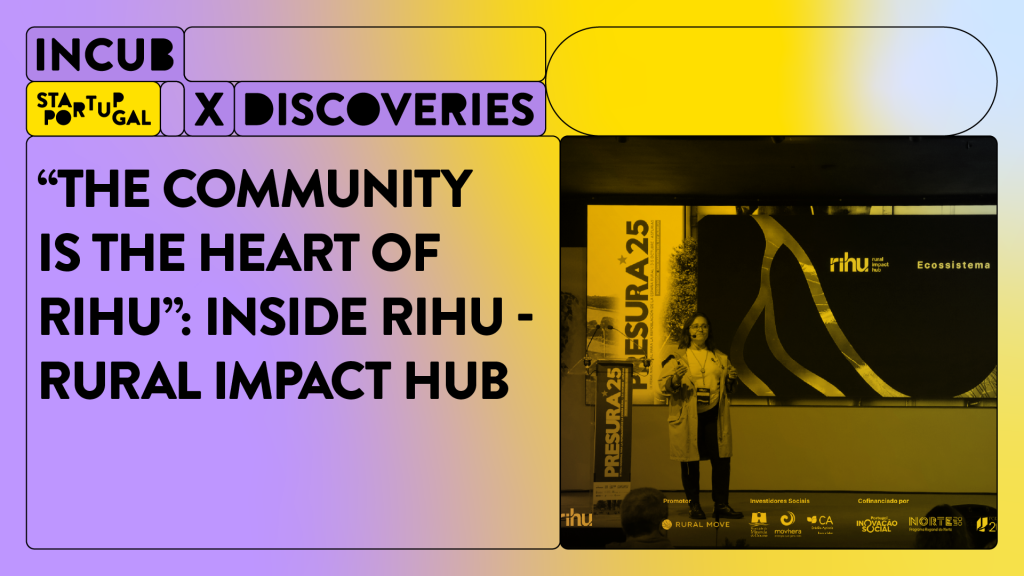
In this edition of #IncubXdiscoveries, we feature RIHU – Rural Impact Hub, an incubator designed from the territory to support impact-driven projects in rural and low-density areas. We spoke with João Almeida, Co-Founder and Coordinator of Rural Move, about how RIHU was built around community engagement, what “impact entrepreneurship” looks like in rural contexts, and the challenges of turning ideas into sustainable projects on the ground.
This content is available in Portuguese.
– How did RIHU – Rural Impact Hub come about? What kind of projects do you incubate?
Rural Impact Hub (RIHU) was born from several years of Rural Move’s direct work in rural and low-density territories. Along that journey, we kept hearing a common message from those who live and work in these areas: there are ideas, there is motivation, but there is a lack of support, structure, and networks to make them happen.
RIHU was created precisely to respond to that gap. It is an incubator designed from the territory, to support projects that want to create social, economic, and environmental impact in rural areas, whether led by those who already live there or by those who want to move and invest in these territories.
We incubate impact entrepreneurship projects with sustainable business models, connected to areas such as social innovation, proximity services, valorization of local resources, sustainable tourism, social economy, agri-food, culture, education, or ecological transition.
– Do you have an area of specialization?
Yes, RIHU is specialized in impact entrepreneurship in rural and low-density territories. That means two things: We work with projects that respond to challenges in rural areas (depopulation, aging, access to services, job creation, valorization of the territory); We adapt methodologies, timelines, and expectations to the reality of these contexts (which is very different from traditional urban or technological logic).
Our specialization is both impact and territory.
– What does your incubation model consist of?
RIHU combines incubation, capacity-building, and community engagement. We do not believe in “desk-based” incubation. Our model includes: Listening and co-creation with the community to identify challenges; Practical capacity-building through bootcamps, trainings, and specialized mentoring; Supported incubation, with continuous support for project development, business model, and impact; Connection to partners, mentors, and social investors, local, national, and international.
It works in a hybrid format: we have a physical space in Miranda do Douro, but also virtual incubation, because we believe in the freedom to live and work where it makes sense.

– Tell us the story of a startup that has made a mark on the incubator. And where has incubating with you made a difference?
RIHU is in an early stage of formal incubation, but it already carries stories from Rural Move’s work. We can give the example of Breves.pt, a project led by a “Mover” (a new resident and remote worker) that is a digital civic infrastructure organizing essential information about local life, making visible what happens in communities, reducing information fragmentation, and contributing to more informed and participatory communities.
Another initiative that is marking RIHU is supporting the Girasolo Learning Community, led by two entrepreneurs who decided to invest in the territory they chose to live in with their families. The entrepreneurs developed an educational methodology for children in primary school (1st cycle), especially designed for rural territories, navigating between the free play of preschool and the formal demands of basic education.
RIHU’s work with these and other projects is strongly oriented toward giving structure to ideas, namely by clarifying the value proposition, the impact model, and the business and funding model.
– Failure is also part of the journey. What did you learn most from something that didn’t go well?
We learned that it is not enough to bring urban models into the rural world. Not all formats, rhythms, or solutions work the same way. The biggest mistake would be imposing external solutions without listening. Impact is built with proximity and humility.
– What is the differentiating factor of your incubator? In other words, what is it about you that makes you unique and enhances the success of the startups you incubate?
RIHU is different because: It works in the territory and with the territory, not only for it; It brings together social innovation, entrepreneurship, and local development in a single ecosystem; It values both those who already live there and those who want to arrive; It has a strong connection to the community, municipalities, and local associations.
Through this, we put into practice the purpose of the Rural Move Association: to be the meeting point of the new rurality.
– What kind of projects or startups are you looking for now?
We are looking for projects with clear positive impact in rural territories. Projects can be at the idea, validation, or early activity stage. They can be led by any person or entity that wants to implement the project in low-density territories.
More than a vertical, we value the connection to the territory and the will to create solutions with lasting impact in the rural world.
– Community is one of the factors that distinguishes an incubator from an office center. How do you look after yours and what plans do you have to make it more cohesive and fertile?
Community is the heart of RIHU and what truly sets us apart from a simple incubation space. We take care of it with time, presence, and consistency. We aim to create regular moments of meeting, listening, and co-creation, promoting peer learning, facilitating connections between projects, mentors, and partners, and maintaining close and accessible communication. Our ambition is to build a living community, where there is real sharing and collaboration, and where projects do not grow in isolation, but together, with the territory.
– What are the main challenges for incubation in your specific context?
The main challenge of incubation in a rural context is working in a territory shaped by decades of depopulation, aging, and lack of sustained investment. This often translates into less critical mass, less access to resources, and greater distrust toward new initiatives. At the same time, there is the challenge of countering the idea that innovation and entrepreneurship only happen in major urban centers. At RIHU, we see these challenges as part of the work: adapting methodologies, respecting local rhythms, and showing, in practice, that it is possible to create viable, innovative projects with impact from the rural world.
– Do you want to share any news with us? Any events or initiatives that we should all keep in our agendas?
Right now, RIHU is taking very concrete steps on the ground. We are starting co-creation sessions in several parishes, work in schools, networking events, and supporting 14+ incubated projects. More than launching initiatives, we are building an ecosystem where entrepreneurs, associations, young people, and communities feel part of something bigger. The invitation to visit RIHU and Miranda do Douro is open to anyone who believes the future is also built from rural territories.
ABOUT #INCUBXDISCOVERIES
#IncubXdiscoveries is Startup Portugal’s monthly feature that will help you discover Portuguese incubators. What projects they incubate, how they manage their community and what success stories they’ve had and future projects are some of the topics covered in these interviews.
If you’d like to find out more about RIHU – Rural Impact Hub, either because you’d like to see your project incubated in this region or because you’d like to establish a partnership, contact the Startup Portugal team at incubadoras@startupportugal.com.
Other blog posts