“The problem as an opportunity”: the thesis of UBImedical
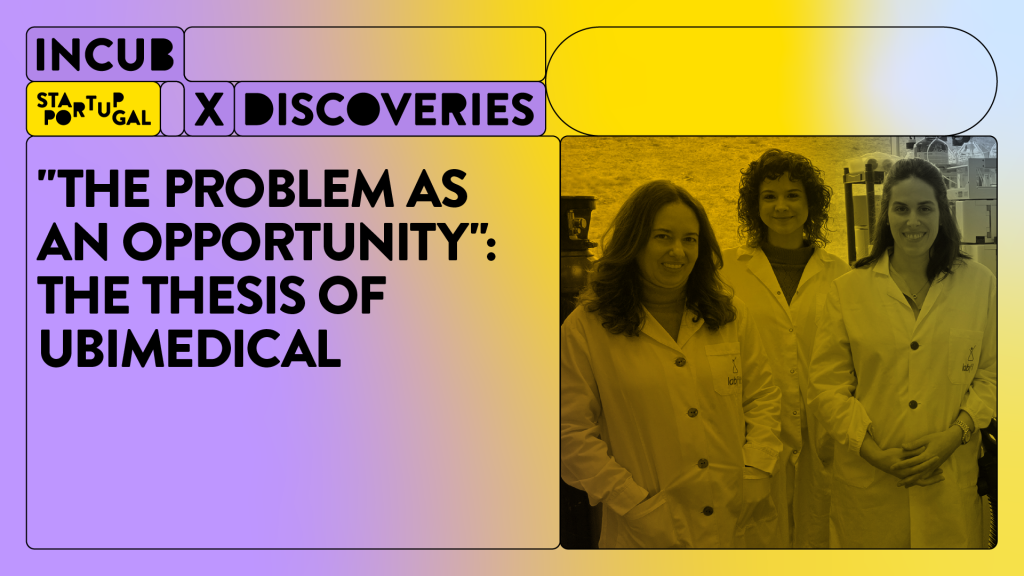
In this edition of #IncubXdiscoveries, we feature UBImedical, an incubator created within the University of Beira Interior (UBI) to build a bridge between research and the market in health and life sciences. We spoke with Dina Pereira, Executive Director at UBImedical. UBImedical has Professor Sílvia Socorro, Vice-Rector for Research, Innovation and Development, in its leadership.
This content is available in Portuguese.
– How did UBImedical come about? What kind of projects do you incubate?
UBImedical was created within the University of Beira Interior with the mission of promoting scientific and technological knowledge in the areas of health and life sciences. It arose from the need to build an effective bridge between academic research and the market, supporting the transformation of innovative ideas into solutions with real impact. We incubate science and technology-based projects and startups, from the idea stage and early stage, and accompany them until they enter the market and scale up. In addition to projects in the area of health and life sciences, we invest heavily in incubating startups linked to deeptech and artificial intelligence, areas of scientific strength at the University of Beira Interior.
– Do you have an area of specialization?
UBImedical specialises in two verticals: life sciences, encompassing biotechnology, pharmaceuticals, medical devices, digital health and medtech; and artificial intelligence.
– What does your incubation model consist of?
Incubation at UBImedical can take place in three ways: virtual, co-working (shared office with other companies) and in person (own office and/or laboratory). In any of these areas, we offer specialised mentoring, access to laboratory and technological infrastructure, access to our acceleration programmes, connections to researchers, access to a network of investors and strategic partners, as well as support/consultancy in technological, regulatory, industrial property and market validation. We work in a personalised way, adjusting our support to the maturity stage and needs of each project.
– Tell us the story of a startup that has made a mark on the incubator. And where has incubating with you made a difference?
After more than a decade of research and work in the field of neuroscience, NeuroSoV (Fastprinciple, Lda.) was founded in 2020 by a team motivated by the ambition to discover a solution capable of halting or slowing the progression of Parkinson’s disease.
In 2019, NeuroSoV participated in one of UBImedical’s seed capital competitions (HealthCup) and raised 5000€ to leverage the project and 1 year of free incubation at UBImedical. NeuroSoV has now raised over 5.5 million € in non-dilutive funds and has several patents granted (including a patent family granted in several countries).
From a very early stage, incubation at UBImedical was instrumental in helping the team transform scientific knowledge into a product with market potential. Starting with HealthCup and then support in structuring the business plan, validating the solution and connecting with clinical and technological experts, NeuroSoV was able to evolve from promising laboratory research to a startup ready for the challenges of the healthcare sector and internationalisation. The proximity to the University and the framework provided by this ecosystem were also key factors in accelerating its development, reducing risks and strengthening the credibility of the project with partners and investors.
– Failure is also part of the journey. What did you learn most from something that didn’t go well?
One of the lessons learned is that people/teams are a critical factor, both at the incubator level and within startups. Having a multidisciplinary team with various skills and a spirit of collaboration, creativity, and co-creation is essential to meet the demands of growth and specialisation in the ecosystem, which shows us the importance of continuously investing in skills, alignment, and internal culture. The same is true within the startups themselves. Even with a good idea or solid technology, when the team dynamics do not work, the impact on development is inevitable.
There have been cases where some startups have chosen not to consider strategic recommendations given in the context of incubation and mentoring, which reinforces the idea that support is only truly effective when there is openness to listen, test and learn.
Very recently, one of our startups suffered a problem in the laboratory that seriously hampered the experiment in progress. When they talked to me, I suggested using the mistake as an opportunity to test an alternative to the project. We cannot give any more information at this stage… but this could be one of those innovations!
– What is the differentiating factor of your incubator? In other words, what is it about you that makes you unique and enhances the success of the startups you incubate?
The main distinguishing factor of UBImedical is its strong connection to the university, scientific research and the surrounding entrepreneurial ecosystem, as well as its extensive network of contacts. We offer a highly specialised environment with access to technical knowledge, infrastructure and networks that are difficult to find in other generalist incubators. Examples of this are: access to laboratories and facilities at faculty research units for spin-offs and spin-outs, easy access to R&D funds in partnership with the university, proximity to research and the recruitment of newly graduated talent, proximity to a group of regional investors, ease of testing solutions at the University Hospital, or the existence of a Clinical Trials Support Centre within UBImedical.
We organise seed capital competitions that offer all participants a pre-pitch competition course, where all projects can refine their idea and prepare/improve their pitch, and where the winners receive a year of pre-incubation at UBImedical, entry into the acceleration programme, and capital to leverage their project. In addition, we cultivate a culture of collaboration and synergy between the various incubated startups and promote various networking events between startups and between startups and investors and/or partners.
There is something I must emphasise about our ecosystem – the fact that we all operate as a community, everyone helps each other, whether it is looking for investors, partners, spreading the word, and co-creating.
– What kind of projects or startups are you looking for now?
Science and technology-based projects and startups with a strong research and development component, from the ideation, early stage or scale-up phase. We value multidisciplinary teams with a strong motivation to create social and economic impact, and solutions aligned with current challenges in the areas of health, biotech, health/medtech, deeptech and artificial intelligence.
– Community is one of the factors that distinguishes an incubator from an office center. How do you look after yours and what plans do you have to make it more cohesive and fertile?
We are committed to creating a collaborative community, promoting opportunities for sharing, networking, mentoring and joint learning. We encourage collaboration between startups, researchers and external partners. We also ensure that incubatees feel supported by the incubator, screen funding programmes and provide support/advice on applications.
Many of our companies need traction, to experiment in the field, and as we have a strong knowledge of the community and entities, both public and private, we facilitate this connection. For the future, we want to continue to reinforce this dynamic with more themed events, joint programmes and initiatives that promote co-creation and a sense of belonging.
– What are the main challenges for incubation in your specific context
One of the main challenges is that we are located in a low-density area, which requires additional effort to attract talent, investment and partners. In addition, many of the startups are in the health/pharmaceutical/medical device sector, presenting specific challenges such as regulation, long development cycles and the need for clinical validation, which require time, resources and specialised monitoring.
Another challenge is the need to attract anchor companies to the region in our strong verticals to serve as leverage for our startups.
– Do you want to share any news with us? Any events or initiatives that we should all keep in our agendas?
We will soon begin organising HealthCup 2026, and in April we will hold Innov Summit’26, an event co-organised by UBImedical, UBI, and the Municipality of Covilhã.
ABOUT #INCUBXDISCOVERIES
#IncubXdiscoveries is Startup Portugal’s monthly feature that will help you discover Portuguese incubators. What projects they incubate, how they manage their community and what success stories they’ve had and future projects are some of the topics covered in these interviews.
If you’d like to find out more about UBImedical, either because you’d like to see your project incubated in this region or because you’d like to establish a partnership, contact the Startup Portugal team at incubadoras@startupportugal.com.
Other blog posts